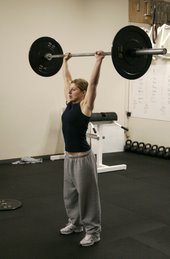
My flight is delayed. Not really but it’s a stall as I cooling my jets in a departure terminal where all I can do is make up interesting lies about the people around me and justify the consumption of comfort food just for something to do. It takes a very dedicated chunk of time and the memorization of multiple formulae in the mastery of calorie calculus just to convince myself that frozen yogurt counts as a protein or that Nachos can somehow meet 40/30/30 requirements. But it becomes so much easier to sit around and I become so much more compliant when I’ve been numbed by carbohydrates and boredom. That’s me in the gym right now – bags packed with 90K, waiting for progress and trying not to put the kind of non-nutrients in my mouth that will just make the job of pushing weight even harder.
I’m trying not to know – if ‘knowing’ makes it so – that the Monday Night Squat progression is going to be a battle as I revisit 90K over and over again. I’ll either push like hell to keep the weight moving up or it will push like hell to keep me stuffed in a compact little bundle buckled beneath the weight. It takes an excruciatingly long time to decide whether or not I’ll bail. At this point, I’m the Susan Lucci of squat night and I smile at each failure like I’m just happy to be nominated.
Nothing personal, I’m sure. 90K and I greet each other politely and I try to pretend we’re working together. I saunter up to it in a friendly enough way and make like we’re pals. I even drape my arms over the bar sometimes and lean casually as if we’re that comfortable with each other. But secretly I think it mocks me and talks behind my back. I want to get passed it. I want to be able to talk about it in breezy tones as if I barely remember our meeting. But somehow 90K knows that I’m only three beers away from drunk-dialing it and simpering about why it doesn’t like me.
I ask myself a lot of questions in the postmortem about what I ate, how I slept, how I trained. These are the kinds of variables that affect me on any given day. At first the notations in my training log were sensical and almost sciency. “DOMS from Friday” but after awhile the shaky and frantic script became a muddled mix of paranoia and superstition like, “the rack was moved into a hell mouth,” “Saturn’s rising and it unbalanced my aura.”
I’m not sure people want to work at my rack anymore and it’s not just for fear of falling objects. I think they fear I’m a contagion of calamity. I’m funking the bar with a heavy residue of a glute deteriorating bacteria or I’m plagued by the ghosts of failed lifts past. Either way, I’m messing with Chi especially my own. And it’s like tripping in public or whatever other graceless act you care to commit, you figure if you jump up immediately it somehow diminishes the memory in other people’s minds so that, if you’re fast enough, it’s like you never did it at all. Um, sure.
About a month ago, it was time to do the CrossFit total. I initially approached it with the same zeal and enthusiasm I’d muster for root canal. With my rotator cuff injury, the only positive thing I can say about the Overhead Press is, at least my arms are short. That makes the process of pushing things to lockout painful but not prolonged. My body generally rejects the effort at about the point when the bar reaches my eyeballs and my brain decides to detour around the supraspinatus by taking some indirect and unsuccessful path around the bar. It’s ugly and relatively harmless. The Deadlift is something I haven’t been dying to do since the strongman competition when I didn’t feel as if I was lifting weight as much as birthing it. And the squat, well, you know about the squat.
I considered the ever appetizing no-show served, to anybody who asked, in a big steaming ragu of reasons and excuses and seasoned with drama. My inner Diva was cooking up a heart wrenching tale of rotator cuff betrayal and the unrequited love of 90K; complete with big dance numbers all bollywood style. But then, unlike the average diva, I considered the other people in the room. First, there was the poor bloke who walked in with a simple question of “are you doing the total?” and ended up with the time-suck of bullshit. Yeah, that shoulda been a ‘yes’ or ‘no’ moment. And, second, all the other women who are looking for a template of what to do when it starts to get hard. ‘Quit, cry on a shoulder, and have excuses ready’ isn’t what they deserve for an answer.
If I’m not remembered for getting passed 90k on the protocol, I’ll be remembered for never letting it drop me. There’s a lesson in this and I’m not going to let that lesson be about how to quit. If other women show up and see me struggle maybe they’ll understand that struggle is part of it too. Or maybe they’ll get that this is about work and not about genetic blessings. Whatever they get, it’s more valuable than anything they’d get from me not showing up.
In the end, I met my goal of 561 pounds. The Squat was a PR, the Overhead Press was disappointing but respectable and the Deadlift, though not a PR, was significantly heavier than my last combined effort. In total, it’s what I set out to do though with a different breakdown than I imagined. It hasn’t stopped the 90K from hitting the floor though. What will keep the weight on my back is this: limit my metabolic conditioning, eat to support what I’m doing which will likely mean a push to gain weight and manage my sleep to ensure at least eight hours. It means becoming a sport-specific athlete.
These aren’t all sacrifices I’m willing to make so in the meantime I’m listening to my coach and doing what I’m told. After all, the point of having a coach isn't to ignore the expertise, do what I want anyway and keep the guy around just to fight with. The carnival ride in my cranium is usually a dizzying tilt-o-whirl of nonsense. In twelve hour bouts that turns out to be fun for only a little while. While I’m busy trying not to throw up on the ride, let him operate that part of my life for awhile. In order to get passed the things I’ve failed at, I’m going to need better inputs then the ones I’ve already used to fail with.
And that brings me to the other lesson I learn as I hang out in this holding pattern: If it’s true that the universe line-drives you with the same crap you’re belting out, then perhaps, as a coach, I should consider how coachable I’m being. Otherwise, my schedule could soon be filled with ornery foot-stompers with questionable fortitude. Hmmm, I’d rather give that 90K another go.
Showing posts with label Training. Show all posts
Showing posts with label Training. Show all posts
Sunday, October 14, 2007
Monday, July 30, 2007
Long, Slow Distance Equals Short, Fast Aging
How many different ways can I ding endurance sports, you wonder? Think of it as a public service. And it's not really me. It wasn't that many years ago that I ran seven miles a day just to chase 'fitness' and it always eluded me. I'm still recovering from the muscular imbalances and long, slow toll it took on my mechanics. Though I obviously have strong opinions, I am merely offering examples of experts that are trying to shovel away the knee-deep pile of Gu the public seems to be mired in thanks to modern media (and Cliff).
This article 'Training is no guarantee of health' that discusses the rapid aging experienced by endurance athletes is particularly interesting because it's written by Mark Sisson, a respected endurance athlete, who reformed his exercise habits to alter the course of his long-term health. This article is also very well written and explains the issue in a clear and direct way. It landed in my in-box thanks to Craig Cooper at NorthWest CrossFit.
This article 'Training is no guarantee of health' that discusses the rapid aging experienced by endurance athletes is particularly interesting because it's written by Mark Sisson, a respected endurance athlete, who reformed his exercise habits to alter the course of his long-term health. This article is also very well written and explains the issue in a clear and direct way. It landed in my in-box thanks to Craig Cooper at NorthWest CrossFit.


Monday, July 2, 2007
Snazzy Remix
I often tell people that my job is to say the same thing every day as if for the first time. At some point I have to trust that it will permeate even the most stubborn brands of denial. There are a few key concepts that will never change about fitness and yet it's those very concepts that make a lot of people push back. Though the conversation is sometimes compelling and it keeps me employed, ultimately weight loss is still a math problem and too much of any one thing will likely break you in some way. True and true.
Here's another catchy remix of one of my favorites, sung to a slightly different tune:
Cutting Back on Endurance Volume May Not Reduce Aerobic Capacity
Traditional endurance training models that emphasize very high volumes and moderate intensities, although practiced by nearly all elite, endurance athletes, are a primary factor in the high rate of chronic overuse injury in endurance sports. Consequently, research has sought alternative methods for optimizing endurance performance while reducing injury. Preliminary studies on high intensity resistance exercise and explosive or plyometric training have been promising.
One concern expressed by endurance athletes, is the effect that replacing endurance training volume with anaerobic training will have on maximal aerobic capacity; a determinant of endurance performance. A recent study published in the International Journal of Sports Medicine may help quell this fear. The researchers determined that max VO2 is unaffected when up to 20% of endurance training volume is replaced by explosive training.
Twenty-five 16-18 year old distance runners participated in the 8-week study. The participants were divided into two groups, one replacing ~20% of total endurance training volume with power/explosive training. Total training volume was equivalent between groups. The researchers completed pre- and post-assessment of top speed during anaerobic running and 30-m speed, top speed of aerobic running, maximal oxygen uptake, running economy, concentric and isometric leg extension, rate of force production in leg extension, and quadriceps size.
The explosive training group experienced small but significant changes in neuromuscular performance and anaerobic measures, including increased rectus femoris size. Increases in lean body mass or muscle hypertrophy is not often found during training of endurance athletes.
Although measures of aerobic performance were not improved, the fact that there was no decline is an important finding. Supplementing endurance training, and reducing endurance volume, by integrating more explosive and resistance exercise may reduce injuries by increasing muscle strength/size, increasing neuromuscular performance and reducing repetitive stress of movement.
Mikkola, J. et al (2007) Concurrent Endurance and Explosive Type Strength Training Improves Neuromuscular and Anaerobic Characteristics in Young Distance Runners. International Journal of Sports Medicine.
Here's another catchy remix of one of my favorites, sung to a slightly different tune:
Cutting Back on Endurance Volume May Not Reduce Aerobic Capacity
Traditional endurance training models that emphasize very high volumes and moderate intensities, although practiced by nearly all elite, endurance athletes, are a primary factor in the high rate of chronic overuse injury in endurance sports. Consequently, research has sought alternative methods for optimizing endurance performance while reducing injury. Preliminary studies on high intensity resistance exercise and explosive or plyometric training have been promising.
One concern expressed by endurance athletes, is the effect that replacing endurance training volume with anaerobic training will have on maximal aerobic capacity; a determinant of endurance performance. A recent study published in the International Journal of Sports Medicine may help quell this fear. The researchers determined that max VO2 is unaffected when up to 20% of endurance training volume is replaced by explosive training.
Twenty-five 16-18 year old distance runners participated in the 8-week study. The participants were divided into two groups, one replacing ~20% of total endurance training volume with power/explosive training. Total training volume was equivalent between groups. The researchers completed pre- and post-assessment of top speed during anaerobic running and 30-m speed, top speed of aerobic running, maximal oxygen uptake, running economy, concentric and isometric leg extension, rate of force production in leg extension, and quadriceps size.
The explosive training group experienced small but significant changes in neuromuscular performance and anaerobic measures, including increased rectus femoris size. Increases in lean body mass or muscle hypertrophy is not often found during training of endurance athletes.
Although measures of aerobic performance were not improved, the fact that there was no decline is an important finding. Supplementing endurance training, and reducing endurance volume, by integrating more explosive and resistance exercise may reduce injuries by increasing muscle strength/size, increasing neuromuscular performance and reducing repetitive stress of movement.
Mikkola, J. et al (2007) Concurrent Endurance and Explosive Type Strength Training Improves Neuromuscular and Anaerobic Characteristics in Young Distance Runners. International Journal of Sports Medicine.
Sunday, May 6, 2007
Where's my bunny?
I'm meandering through a miasma of fatigue this morning but I'm at home with my com padres on The Hill. They all have hangovers. We're being propped up by invisible girder work - the mysterious physics of civil order - queuing for coffee. It might just be as simple as the smell and the knowledge that caffeine saves that holds us all erect but swaying. Either way, we're comfortably in our PJ's and only mildly pretending that the clothes we're wearing weren't peeled off the floor or slept in.
I did the CrossFit Total yesterday which today feels like a fifth of tequila and a couple of drunken tumbles. I taxed my muscles, my central nervous system and my will in a combination of max squat, max deadlift and max overhead press to firmly establish a meaningless ranking. I feel like I was mugged, stripped of my valuables and left for dead. I'm wondering as I hold my place in line if that wasn't nearly as toxic as the guy behind me who may have spent his evening drinking good martinis and having poorly-reasoned sex with a bad date. How, I wonder, did that rank?
I say it was a 'meaningless' ranking only because it's no resume builder and if I nudged the hungover guy behind me to share my triumph he probably couldn't muster the energy to be interested. It means something only to those of us who showed up and only to the degree in which we consider it a measure of anything.
In those three lifts I squatted, lifted and pressed 550 pounds. That's a lot of weight for a little middle-aged woman. My body would be happy to explain the impact of that if it wasn't busy trying to make me nap.
For me it's a number and a scenic overlook. I'm not 'there' yet - as if there's a 'there' there. But that long path I've taken is suddenly visible when I peer over the guardrails and I get a hint of how far I've come. At least for that fleeting moment until I swerve back onto the road.
Reasons, reasons, excuses, justifications, analysis and more reasons. Competitions like that are never as simple as getting weight to move. If it were only as easy as 'it was too heavy' we would never shy away from the platform. What stops us can be so many things and most of them are made up to explain some flavor of fear. My usual answer to failure is "I zigged when I should have zagged" in the immortal words of Bugs Bunny. Does it really matter? Most of the reasons are just Monday morning quarterback answers for why I wasn't there when I showed up. Figuring out why is such an easy sport but lifting the weight is so much harder.
What happened yesterday was that a lot of people picked up or pushed a lot of heavy things. That's not even interesting. The epic battle was the one going on in everybody's head and it was electric and tangible.
My battle was the same. I can out-lift every woman in the room - that's not judgement, I've just been doing this longer and I'll be happy to welcome them here when they decide they want to be 'there'. But I've become the first target for every man who walks in the door. Step 1 in world domination - beat the girl. I'm the carcass to step over. When that happens, it's expected because most of them will have the genetic potential to beat me - it's a boy/girl thing.
The guys all sat around the bar afterwards and had a long conversation about who they edged out and who is on their radar. They tasted victory but were spurred on by the sounds of noisy pursuit just at their backs. They talked about who was 'the bunny' to chase in a race with long odds. I sat quietly like the awkward 'tween' - not so much a kid, not so much an adolescent. I have no bunny, except the noisy scaredy-cat in my head that makes me drop things sometimes.
The competitor at your back can sometimes have more respect for you than you do. The clamour they make drowns out whatever noise your head generates. I would like to have that adversary who fears me and who I fear. It would keep me from crawling into my own mean thoughts which is proving the nastier fight for me right now.
I did the CrossFit Total yesterday which today feels like a fifth of tequila and a couple of drunken tumbles. I taxed my muscles, my central nervous system and my will in a combination of max squat, max deadlift and max overhead press to firmly establish a meaningless ranking. I feel like I was mugged, stripped of my valuables and left for dead. I'm wondering as I hold my place in line if that wasn't nearly as toxic as the guy behind me who may have spent his evening drinking good martinis and having poorly-reasoned sex with a bad date. How, I wonder, did that rank?
I say it was a 'meaningless' ranking only because it's no resume builder and if I nudged the hungover guy behind me to share my triumph he probably couldn't muster the energy to be interested. It means something only to those of us who showed up and only to the degree in which we consider it a measure of anything.
In those three lifts I squatted, lifted and pressed 550 pounds. That's a lot of weight for a little middle-aged woman. My body would be happy to explain the impact of that if it wasn't busy trying to make me nap.
For me it's a number and a scenic overlook. I'm not 'there' yet - as if there's a 'there' there. But that long path I've taken is suddenly visible when I peer over the guardrails and I get a hint of how far I've come. At least for that fleeting moment until I swerve back onto the road.
Reasons, reasons, excuses, justifications, analysis and more reasons. Competitions like that are never as simple as getting weight to move. If it were only as easy as 'it was too heavy' we would never shy away from the platform. What stops us can be so many things and most of them are made up to explain some flavor of fear. My usual answer to failure is "I zigged when I should have zagged" in the immortal words of Bugs Bunny. Does it really matter? Most of the reasons are just Monday morning quarterback answers for why I wasn't there when I showed up. Figuring out why is such an easy sport but lifting the weight is so much harder.
What happened yesterday was that a lot of people picked up or pushed a lot of heavy things. That's not even interesting. The epic battle was the one going on in everybody's head and it was electric and tangible.
My battle was the same. I can out-lift every woman in the room - that's not judgement, I've just been doing this longer and I'll be happy to welcome them here when they decide they want to be 'there'. But I've become the first target for every man who walks in the door. Step 1 in world domination - beat the girl. I'm the carcass to step over. When that happens, it's expected because most of them will have the genetic potential to beat me - it's a boy/girl thing.
The guys all sat around the bar afterwards and had a long conversation about who they edged out and who is on their radar. They tasted victory but were spurred on by the sounds of noisy pursuit just at their backs. They talked about who was 'the bunny' to chase in a race with long odds. I sat quietly like the awkward 'tween' - not so much a kid, not so much an adolescent. I have no bunny, except the noisy scaredy-cat in my head that makes me drop things sometimes.
The competitor at your back can sometimes have more respect for you than you do. The clamour they make drowns out whatever noise your head generates. I would like to have that adversary who fears me and who I fear. It would keep me from crawling into my own mean thoughts which is proving the nastier fight for me right now.
Tuesday, April 24, 2007
Snatched from the Couch
I sat at Top Pot Doughnuts - hey, free WiFi - and read the following article about explosive exercise for a middle aged population. I was thinking, "cool, that's perfect for those middle aged folks." I'm 37. I am those middle aged folks. Upon realization, I won't lie, I almost ate a doughnut. Instead I sipped my Earl Grey like I'm all young and hip . . . . wait . . . .
The study was done in Finland where apparently they aren't afraid to get sued by a bunch of 30-somethings with ankle sprains and various maladies to whine about. They peeled them right off the coach and made them jump. That's beautiful. And if the following statement doesn't make you cry, you're just dead inside:
"With increasing age, the capacity to produce explosive muscle force declines more dramatically than maximal muscle strength. To maintain functional capacity, strength training and power-type strength training are recommended for middle aged and elderly people."
Notice that they didn't say, "With increasing age, the capacity to produce explosive muscle force declines more dramatically then maximal muscle strength. So, give it up, take up mall walking buy a chair to haul your butt up the stairs to your Craftmatic adjustable bed and start making excuses for why you can't, won't and don't."
"The injury rate in this study was low (19% in men and 6% in women). For comparison, injury rates ranging from 24% to 40% have been reported among middle aged male and female runners; knee injuries were the most common. Correspondingly, the injury rate was 12% for middle aged sedentary male and female participants in a supervised one year worksite exercise programme."
Injury is a convenient excuse used by a trainer who can't coach explosive movements and don't have a clue about the proper progression. The finger wagging injury conversation is the easiest way for a lazy trainer to get paid the same per hour without adding any additional tools to his/her skill set. I know that I honestly would never have figured out Coach Bergener's snatch progression on my own but because he poured his wisdom into that little piece of genius, I'm able to teach my clients. First, though, I had to put in the time to learn it.
"Despite the high amount of jump and sprint exercises in the training programme, knee symptoms did not show any significant increase compared with the non-exercising control group, which certainly contributed to the increase in self rated health and fitness among participants. However, old knee troubles recurred in male participants who had previously practised various kinds of sports that stress the knees, such as ball games. High BMI may also have increased the risk of knee disorders. Knee symptoms, especially knee pain itself without any exercise involved, are associated with poor perceived health and increased mental distress. In this study, the interruptions in training were short, indicating that the disorders and injuries were not serious."
I went to Dr. Rowe, my family physician, when I was a freshman in college. I had recurring knee pain that he once diagnosed as 'growing pains.' Given that I was the same 5 feet, 4 inches since the age of fourteen, something wasn't right. At this point, given all the aching, I should have been over ten feet tall. He poked, he prodded and he then looked at my philosophically, "sometimes things just hurt," he said. My insurance paid for the visit.
I had a friend who gave me place mats made in Zimbabwe - worst mass production ever. None of them were the same size and all the seems were crooked. Our bodies are like products from Zimbabwe - sometimes it's not the best craftsmanship. I remember watching 'Mini Med School' on PBS and the doctor was saying that one of the most vexing parts of spinal surgery is that everything looks completely different when you open someone up. Given that, it's no surprise that we have aches and pains and things that hurt. Sometimes we work through them and sometimes we work around them. It isn't a good reason to quit.
Feasibility of power-type strength training for middle aged men and women: self perception, musculoskeletal symptoms, and injury rates.
Surakka J, Aunola S, Nordblad T, Karppi SL, Alanen E.
Social Insurance Institution, Research and Development Centre, Turku, Finland. jukka.surakka@kela.memonet.fi
OBJECTIVES: To examine the feasibility of a power-type strength training programme for middle aged men and women, the impact of the training programme on perceived health and fitness and on knee and low back symptoms, and the rate of exercise induced injuries.
METHODS: A total of 154 voluntary, healthy, sedentary men and women participated in a training programme lasting about four months. The explosive force of leg extensor muscles was measured by means of standing long jumps and vertical squat jumps. Perceived health, perceived fitness, and low back and knee symptoms were assessed before and after the intervention by using a questionnaire. Musculoskeletal disorders and exercise induced injuries were reported during the training programme.
RESULTS: Perceived fitness improved in both men (p<0.01) and women (p<0.0001), but perceived health only in women (p<0.01). Men with increased explosive force in squat jumping also showed better perceived health (p<0.05), and women with increased explosive force in standing long jump showed better perceived fitness (p<0.05). Exercising men who had increased knee symptoms had significantly higher body mass index than the other exercising men (p<0.05). The exercise induced injury rate was 19% in men and 6% in women.
CONCLUSIONS: Successful completion of the exercise programme, together with the increased physical activity and relatively low injury rate, may have contributed to the participants finding the exercise programme positive and stimulating and believing that their health and fitness had improved. The low rate of musculoskeletal injury suggests that this type of supervised exercise programme is feasible for untrained middle aged people.
The study was done in Finland where apparently they aren't afraid to get sued by a bunch of 30-somethings with ankle sprains and various maladies to whine about. They peeled them right off the coach and made them jump. That's beautiful. And if the following statement doesn't make you cry, you're just dead inside:
"With increasing age, the capacity to produce explosive muscle force declines more dramatically than maximal muscle strength. To maintain functional capacity, strength training and power-type strength training are recommended for middle aged and elderly people."
Notice that they didn't say, "With increasing age, the capacity to produce explosive muscle force declines more dramatically then maximal muscle strength. So, give it up, take up mall walking buy a chair to haul your butt up the stairs to your Craftmatic adjustable bed and start making excuses for why you can't, won't and don't."
"The injury rate in this study was low (19% in men and 6% in women). For comparison, injury rates ranging from 24% to 40% have been reported among middle aged male and female runners; knee injuries were the most common. Correspondingly, the injury rate was 12% for middle aged sedentary male and female participants in a supervised one year worksite exercise programme."
Injury is a convenient excuse used by a trainer who can't coach explosive movements and don't have a clue about the proper progression. The finger wagging injury conversation is the easiest way for a lazy trainer to get paid the same per hour without adding any additional tools to his/her skill set. I know that I honestly would never have figured out Coach Bergener's snatch progression on my own but because he poured his wisdom into that little piece of genius, I'm able to teach my clients. First, though, I had to put in the time to learn it.
"Despite the high amount of jump and sprint exercises in the training programme, knee symptoms did not show any significant increase compared with the non-exercising control group, which certainly contributed to the increase in self rated health and fitness among participants. However, old knee troubles recurred in male participants who had previously practised various kinds of sports that stress the knees, such as ball games. High BMI may also have increased the risk of knee disorders. Knee symptoms, especially knee pain itself without any exercise involved, are associated with poor perceived health and increased mental distress. In this study, the interruptions in training were short, indicating that the disorders and injuries were not serious."
I went to Dr. Rowe, my family physician, when I was a freshman in college. I had recurring knee pain that he once diagnosed as 'growing pains.' Given that I was the same 5 feet, 4 inches since the age of fourteen, something wasn't right. At this point, given all the aching, I should have been over ten feet tall. He poked, he prodded and he then looked at my philosophically, "sometimes things just hurt," he said. My insurance paid for the visit.
I had a friend who gave me place mats made in Zimbabwe - worst mass production ever. None of them were the same size and all the seems were crooked. Our bodies are like products from Zimbabwe - sometimes it's not the best craftsmanship. I remember watching 'Mini Med School' on PBS and the doctor was saying that one of the most vexing parts of spinal surgery is that everything looks completely different when you open someone up. Given that, it's no surprise that we have aches and pains and things that hurt. Sometimes we work through them and sometimes we work around them. It isn't a good reason to quit.
Feasibility of power-type strength training for middle aged men and women: self perception, musculoskeletal symptoms, and injury rates.
Surakka J, Aunola S, Nordblad T, Karppi SL, Alanen E.
Social Insurance Institution, Research and Development Centre, Turku, Finland. jukka.surakka@kela.memonet.fi
OBJECTIVES: To examine the feasibility of a power-type strength training programme for middle aged men and women, the impact of the training programme on perceived health and fitness and on knee and low back symptoms, and the rate of exercise induced injuries.
METHODS: A total of 154 voluntary, healthy, sedentary men and women participated in a training programme lasting about four months. The explosive force of leg extensor muscles was measured by means of standing long jumps and vertical squat jumps. Perceived health, perceived fitness, and low back and knee symptoms were assessed before and after the intervention by using a questionnaire. Musculoskeletal disorders and exercise induced injuries were reported during the training programme.
RESULTS: Perceived fitness improved in both men (p<0.01) and women (p<0.0001), but perceived health only in women (p<0.01). Men with increased explosive force in squat jumping also showed better perceived health (p<0.05), and women with increased explosive force in standing long jump showed better perceived fitness (p<0.05). Exercising men who had increased knee symptoms had significantly higher body mass index than the other exercising men (p<0.05). The exercise induced injury rate was 19% in men and 6% in women.
CONCLUSIONS: Successful completion of the exercise programme, together with the increased physical activity and relatively low injury rate, may have contributed to the participants finding the exercise programme positive and stimulating and believing that their health and fitness had improved. The low rate of musculoskeletal injury suggests that this type of supervised exercise programme is feasible for untrained middle aged people.
Br J Sports Med 2003;37:131-136© 2003 BMJ Publishing Group & British Association of Sport and Exercise Medicine
Tuesday, April 17, 2007
Lean On Me
Do you suppose it's a coincidence that I generally publish research that agrees with me? I'm sure every resource I draw on has some distance runner flapping reams of contrary data in opposition. They'll have a counter argument - a long, slow, muscle-wasting diatribe I'm sure. But again I say, there's nothing wrong with endurance athletics as long as it's done for the right reasons. I assume to atone for unspeakable sin.
In that vain, Alwyn Cosgrove recently wrote an article for Testosterone called The Hierarchy of Fat Loss which sounded as titillating to me as Cosmopolitan's Every-Issue tease that in this issue - THIS VERY ISSUE - the secret to getting your abundant backside into a size zero is revealed. I think I read that article every month while I was in high school and every month my 'abundance' remained to startle me whenever I saw my profile in shadow. It continues to sneak up on me from time to time when I'm not looking.
Alas, I figured, it was Alwyn Cosgrove - with whom I often agree - and I had nothing else to do since I already read my freakishly accurate Horoscope in the Seattle Weekly so I gave the article a quick once over. This stuff wasn't new but then few things I read that are spot-on are.
I've described my job before - at least from the angle of nutrition - as a responsibility to say the same thing every day, without fail and from new and fresh angles in the hopes that one day it lands in the ear like the voice of God with profound prophecy. Try saying, "Hey, why not try eating less . . ." with cheerleader enthusiasm for the umpteenth time (I wanted to say that because it puzzles me that there's an elusive number called 'ump' and all I know about it is that it's very large even before I 'teenth' it).
It would seem tedious that everyone is still talking about 'leaning out' and even slightly incongruent in a world where muffin-tops are almost a fashion accessory. They must be all the rage if designer labels cut jeans in a way that seems to spotlight them in all their bulbous glory. While one group pays obscene 3-digit price tags for clothes that puts body fat on center stage, another pays an equally obscene price on fat-burning supplements that, if their lucky, won't cause organ failure.
Cosgrove had me hooked from the opening line though. "There's pretty much nothing that can be done to out-train a crappy diet." My heart's aflutter.
Caloric Deficit - Now There's a New One
You quite simply have to create a caloric deficit while eating enough protein and essential fats. There's no way around this. Yep. It really is that important. Several trainers have espoused that the only difference between training for muscle gain and training for fat loss is your diet. I think that's a massive oversimplification, but it does reinforce how important and effective correct nutrition is toward your ultimate goal."
Simple, huh? Maybe to you this sounds like the 'new and fresh angle' I was talking about or it counts in the running tally of days-in-a-row I've said this. He then outlines three other key points. All of them might have been mentioned by me before though perhaps without resonating like the words of the Divine.
Resting Metabolic Rate
"I think it's fairly obvious that the bulk of calories burned are determined by our resting metabolic rate or RMR. The amount of calories burned outside of our resting metabolism (through exercise, thermic effect of feeding, etc.) is a smaller contributor to overall calories burned per day. We can also accept that RMR is largely a function of how much muscle you have on your body — and how hard it works. Therefore, adding activities that promote or maintain muscle mass will make that muscle mass work harder and elevate the metabolic rate. This will become our number one training priority when developing fat loss programs."
In other words, not long-duration cardio which doesn't promote lean mass, it depletes it thus putting the burden of caloric deficit on the duration of the workout itself. Which, if you have a couple of hours a day to invest, no worries, but if it turns out you have other things to do . . . . . .
Exercise Post Oxygen Consumption
"The next level of fat loss programming would be a similar activity. We're still looking at activities that eat up calories and increase EPOC. EPOC (Exercise Post Oxygen Consumption) is defined scientifically as the "recovery of metabolic rate back to pre-exercise levels" and "can require several minutes for light exercise and several hours for hard intervals."
Essentially, we're looking for activities that keep us burning more calories after the exercise session."
"Light Exercise" includes long duration cardio. Though the cumulative fatigue of long slow duration makes the work seem anything but 'light', the fact that percentage of VO2 Max during exertion is usually around 60% makes this kind of work 'light' by a more classic definition. Remember, anything you do for two hours straight appears excruciating - I find sitting that long just as trying. If you compare the 600 give-or-take calories burned in an hour of jogging and put it next to the 600 calories in 20 minutes of sprint intervals - the sprints are the gift that keep on giving while the jog is just a flat 600 calorie burn.
Expenditure During Exertion
"This is the "icing on the cake" — adding in activities that'll burn up additional calories but don't necessarily contribute to increasing metabolism. This is the least effective tool in your arsenal as it doesn't burn much outside of the primary exercise session.
Let's put this fat loss continuum together in terms of our progressive training hierarchy."
The Research
Basically we're using resistance training as the cornerstone of our fat loss programming. Our goal is to work every muscle group hard, frequently, and with an intensity that creates a massive "metabolic disturbance" or "afterburn" that leaves the metabolism elevated for several hours post-workout.
Schuenke MD, Mikat RP, McBride JM.
Effect of an acute period of resistance exercise on excess post-exercise oxygen consumption: implications for body mass management.Eur J Appl Physiol. 2002 Mar;86(5):411-7. Epub 2002 Jan 29.
This study used a circuit training protocol of 12 sets in 31 minutes. EPOC was elevated significantly for 38 hours post-workout.
Thirty-eight hours is a pretty significant timeframe for metabolism to be elevated. If you trained at 9AM until 10AM on Monday morning, you're still burning more calories (without training) at midnight on Tuesday.
Can we compound this with additional training within that 38 hours? No research has been done, but I have enough case studies to believe that you can.
If the numbers above were about money, this would be the fodder for a midnight infomercial.
Kramer, Volek et al.
Influence of exercise training on physiological and performance changes with weight loss in men.
Med. Sci. Sports Exerc., Vol. 31, No. 9, pp. 1320-1329, 1999.
Overweight subjects were assigned to three groups: diet-only, diet plus aerobics, diet plus aerobics plus weights. The diet group lost 14.6 pounds of fat in 12 weeks. The aerobic group lost only one more pound (15.6 pounds) than the diet group (training was three times a week starting at 30 minutes and progressing to 50 minutes over the 12 weeks).
The weight training group lost 21.1 pounds of fat (44% and 35% more than diet and aerobic only groups respectively). Basically, the addition of aerobic training didn't result in any real world significant fat loss over dieting alone.
Thirty-six sessions of up to 50 minutes is a lot of work for one additional pound of fat loss. However, the addition of resistance training greatly accelerated fat loss results.
One more:
Bryner RW, Ullrich IH, Sauers J, Donley D, Hornsby G, Kolar M, Yeater R.
Effects of resistance vs. aerobic training combined with an 800 calorie liquid diet on lean body mass and resting metabolic rate.J Am Coll Nutr. 1999 Apr;18(2):115-21.
The aerobic group performed four hours of aerobics per week. The resistance training group performed 2-4 sets of 8-15 reps, 10 exercises, three times per week.
V02 max increased equally in both groups. Both groups lost weight. The resistance training group lost significantly more fat and didn't lose any LBM, even at only 800 calories per day. (The reason the calories were so low was to really take any dietary variables completely out of the equation and compare the effects of the exercise regime on LBM and metabolism.)
The resistance training group actually increased metabolism compared to the aerobic group, which decreased metabolism. It seems that resistance training is a more significant stress to the body than a starvation diet.
In that vain, Alwyn Cosgrove recently wrote an article for Testosterone called The Hierarchy of Fat Loss which sounded as titillating to me as Cosmopolitan's Every-Issue tease that in this issue - THIS VERY ISSUE - the secret to getting your abundant backside into a size zero is revealed. I think I read that article every month while I was in high school and every month my 'abundance' remained to startle me whenever I saw my profile in shadow. It continues to sneak up on me from time to time when I'm not looking.
Alas, I figured, it was Alwyn Cosgrove - with whom I often agree - and I had nothing else to do since I already read my freakishly accurate Horoscope in the Seattle Weekly so I gave the article a quick once over. This stuff wasn't new but then few things I read that are spot-on are.
I've described my job before - at least from the angle of nutrition - as a responsibility to say the same thing every day, without fail and from new and fresh angles in the hopes that one day it lands in the ear like the voice of God with profound prophecy. Try saying, "Hey, why not try eating less . . ." with cheerleader enthusiasm for the umpteenth time (I wanted to say that because it puzzles me that there's an elusive number called 'ump' and all I know about it is that it's very large even before I 'teenth' it).
It would seem tedious that everyone is still talking about 'leaning out' and even slightly incongruent in a world where muffin-tops are almost a fashion accessory. They must be all the rage if designer labels cut jeans in a way that seems to spotlight them in all their bulbous glory. While one group pays obscene 3-digit price tags for clothes that puts body fat on center stage, another pays an equally obscene price on fat-burning supplements that, if their lucky, won't cause organ failure.
Cosgrove had me hooked from the opening line though. "There's pretty much nothing that can be done to out-train a crappy diet." My heart's aflutter.
Caloric Deficit - Now There's a New One
You quite simply have to create a caloric deficit while eating enough protein and essential fats. There's no way around this. Yep. It really is that important. Several trainers have espoused that the only difference between training for muscle gain and training for fat loss is your diet. I think that's a massive oversimplification, but it does reinforce how important and effective correct nutrition is toward your ultimate goal."
Simple, huh? Maybe to you this sounds like the 'new and fresh angle' I was talking about or it counts in the running tally of days-in-a-row I've said this. He then outlines three other key points. All of them might have been mentioned by me before though perhaps without resonating like the words of the Divine.
Resting Metabolic Rate
"I think it's fairly obvious that the bulk of calories burned are determined by our resting metabolic rate or RMR. The amount of calories burned outside of our resting metabolism (through exercise, thermic effect of feeding, etc.) is a smaller contributor to overall calories burned per day. We can also accept that RMR is largely a function of how much muscle you have on your body — and how hard it works. Therefore, adding activities that promote or maintain muscle mass will make that muscle mass work harder and elevate the metabolic rate. This will become our number one training priority when developing fat loss programs."
In other words, not long-duration cardio which doesn't promote lean mass, it depletes it thus putting the burden of caloric deficit on the duration of the workout itself. Which, if you have a couple of hours a day to invest, no worries, but if it turns out you have other things to do . . . . . .
Exercise Post Oxygen Consumption
"The next level of fat loss programming would be a similar activity. We're still looking at activities that eat up calories and increase EPOC. EPOC (Exercise Post Oxygen Consumption) is defined scientifically as the "recovery of metabolic rate back to pre-exercise levels" and "can require several minutes for light exercise and several hours for hard intervals."
Essentially, we're looking for activities that keep us burning more calories after the exercise session."
"Light Exercise" includes long duration cardio. Though the cumulative fatigue of long slow duration makes the work seem anything but 'light', the fact that percentage of VO2 Max during exertion is usually around 60% makes this kind of work 'light' by a more classic definition. Remember, anything you do for two hours straight appears excruciating - I find sitting that long just as trying. If you compare the 600 give-or-take calories burned in an hour of jogging and put it next to the 600 calories in 20 minutes of sprint intervals - the sprints are the gift that keep on giving while the jog is just a flat 600 calorie burn.
Expenditure During Exertion
"This is the "icing on the cake" — adding in activities that'll burn up additional calories but don't necessarily contribute to increasing metabolism. This is the least effective tool in your arsenal as it doesn't burn much outside of the primary exercise session.
Let's put this fat loss continuum together in terms of our progressive training hierarchy."
The Research
Basically we're using resistance training as the cornerstone of our fat loss programming. Our goal is to work every muscle group hard, frequently, and with an intensity that creates a massive "metabolic disturbance" or "afterburn" that leaves the metabolism elevated for several hours post-workout.
Wikipedia might have that definition for 'CrossFit.'
A couple of studies to support this:Schuenke MD, Mikat RP, McBride JM.
Effect of an acute period of resistance exercise on excess post-exercise oxygen consumption: implications for body mass management.Eur J Appl Physiol. 2002 Mar;86(5):411-7. Epub 2002 Jan 29.
This study used a circuit training protocol of 12 sets in 31 minutes. EPOC was elevated significantly for 38 hours post-workout.
Thirty-eight hours is a pretty significant timeframe for metabolism to be elevated. If you trained at 9AM until 10AM on Monday morning, you're still burning more calories (without training) at midnight on Tuesday.
Can we compound this with additional training within that 38 hours? No research has been done, but I have enough case studies to believe that you can.
If the numbers above were about money, this would be the fodder for a midnight infomercial.
Kramer, Volek et al.
Influence of exercise training on physiological and performance changes with weight loss in men.
Med. Sci. Sports Exerc., Vol. 31, No. 9, pp. 1320-1329, 1999.
Overweight subjects were assigned to three groups: diet-only, diet plus aerobics, diet plus aerobics plus weights. The diet group lost 14.6 pounds of fat in 12 weeks. The aerobic group lost only one more pound (15.6 pounds) than the diet group (training was three times a week starting at 30 minutes and progressing to 50 minutes over the 12 weeks).
The weight training group lost 21.1 pounds of fat (44% and 35% more than diet and aerobic only groups respectively). Basically, the addition of aerobic training didn't result in any real world significant fat loss over dieting alone.
Thirty-six sessions of up to 50 minutes is a lot of work for one additional pound of fat loss. However, the addition of resistance training greatly accelerated fat loss results.
One more:
Bryner RW, Ullrich IH, Sauers J, Donley D, Hornsby G, Kolar M, Yeater R.
Effects of resistance vs. aerobic training combined with an 800 calorie liquid diet on lean body mass and resting metabolic rate.J Am Coll Nutr. 1999 Apr;18(2):115-21.
The aerobic group performed four hours of aerobics per week. The resistance training group performed 2-4 sets of 8-15 reps, 10 exercises, three times per week.
V02 max increased equally in both groups. Both groups lost weight. The resistance training group lost significantly more fat and didn't lose any LBM, even at only 800 calories per day. (The reason the calories were so low was to really take any dietary variables completely out of the equation and compare the effects of the exercise regime on LBM and metabolism.)
The resistance training group actually increased metabolism compared to the aerobic group, which decreased metabolism. It seems that resistance training is a more significant stress to the body than a starvation diet.
Tuesday, April 10, 2007
The Flap About Spot Reduction
We trainer's are so darn smart. We sit down with a new client who, when quizzed about goals, inevitably grabs a flap of flesh and points, "I want to get rid of this!" and then shakes the offending handful a little for emphasis. Where the client sees fat, we see an opportunity to educate. How cute, we think. We're going to have the 'you can't spot reduce' conversation now and the client will be wowed by physiology and my command of it. How cute, the client thinks. The trainer is wrong again.
It turns out that you CAN spot reduce. It's minutia really so I wouldn't get worked up and dust off your thigh master just yet. It's notable, however, that many folks in the industry still have only some of the answers but all of the pomposity. Hopefully we'll be able to spot-reduce fat-headedness. Here's the data on the study:
Are blood flow and lipolysis in subcutaneous adipose tissue influenced by contractions in adjacent muscles in humans?
Bente Stallknecht1, Flemming Dela1, and Jorn Wulff HelgeUniversity of Copenhagen, Copenhagen, Denmark
Aerobic exercise increases whole-body adipose tissue lipolysis, but islipolysis higher in subcutaneous adipose tissue (SCAT) adjacent to contracting muscles than in SCAT adjacent to resting muscles? Ten healthy, overnight-fasted males performed one-legged knee extension exercise at 25% of maximal workload (W max) for 30 minutes followed by exercise at 55% Wmax for 120 minutes with the other leg and finally exercised at 85% Wmax for 30 minutes with the first leg.Subjects rested for 30 minutes between exercise periods. Femoral SCAT bloodflow was estimated from washout of 133Xe and lipolysis was calculated fromfemoral SCAT interstitial and arterial glycerol concentrations and blood flow.
In general, blood flow as well as lipolysis was higher in femoral SCAT adjacent to contracting than adjacent to resting muscle (time 15-30 min: blood flow: 25% Wmax: 6.6 ± 1.0 vs. 3.9 ± 0.8 ml 100 g-1 min-1, P < class="blsp-spelling-error" id="SPELLING_ERROR_16">Wmax: 7.3 ± 0.6 vs. 5.0 ± 0.6, P <> 0.05; lipolysis: 25% Wmax: 102 ± 19 vs. 55 ± 14 nmol 100 g-1 min-1, P = 0.06; 55% Wmax: 86 ± 11 vs. 50 ± 20, P > 0.05; 85% Wmax: 88 ± 31 vs. -9 ± 25, P <>
In conclusion, blood flow and lipolysis are generally higher in SCAT adjacent to contracting than adjacent to resting muscle irrespective of exercise intensity. Thus, specific exercises can induce "spot lipolysis" in adipose tissue.
This topic was tossed about in Performance Menu in the forum some time ago but I just got around to mention it. This is interesting stuff but still no cause to flap flesh at me. Use your words.
It turns out that you CAN spot reduce. It's minutia really so I wouldn't get worked up and dust off your thigh master just yet. It's notable, however, that many folks in the industry still have only some of the answers but all of the pomposity. Hopefully we'll be able to spot-reduce fat-headedness. Here's the data on the study:
Are blood flow and lipolysis in subcutaneous adipose tissue influenced by contractions in adjacent muscles in humans?
Bente Stallknecht1, Flemming Dela1, and Jorn Wulff HelgeUniversity of Copenhagen, Copenhagen, Denmark
Aerobic exercise increases whole-body adipose tissue lipolysis, but islipolysis higher in subcutaneous adipose tissue (SCAT) adjacent to contracting muscles than in SCAT adjacent to resting muscles? Ten healthy, overnight-fasted males performed one-legged knee extension exercise at 25% of maximal workload (W max) for 30 minutes followed by exercise at 55% Wmax for 120 minutes with the other leg and finally exercised at 85% Wmax for 30 minutes with the first leg.Subjects rested for 30 minutes between exercise periods. Femoral SCAT bloodflow was estimated from washout of 133Xe and lipolysis was calculated fromfemoral SCAT interstitial and arterial glycerol concentrations and blood flow.
In general, blood flow as well as lipolysis was higher in femoral SCAT adjacent to contracting than adjacent to resting muscle (time 15-30 min: blood flow: 25% Wmax: 6.6 ± 1.0 vs. 3.9 ± 0.8 ml 100 g-1 min-1, P < class="blsp-spelling-error" id="SPELLING_ERROR_16">Wmax: 7.3 ± 0.6 vs. 5.0 ± 0.6, P <> 0.05; lipolysis: 25% Wmax: 102 ± 19 vs. 55 ± 14 nmol 100 g-1 min-1, P = 0.06; 55% Wmax: 86 ± 11 vs. 50 ± 20, P > 0.05; 85% Wmax: 88 ± 31 vs. -9 ± 25, P <>
In conclusion, blood flow and lipolysis are generally higher in SCAT adjacent to contracting than adjacent to resting muscle irrespective of exercise intensity. Thus, specific exercises can induce "spot lipolysis" in adipose tissue.
This topic was tossed about in Performance Menu in the forum some time ago but I just got around to mention it. This is interesting stuff but still no cause to flap flesh at me. Use your words.
Monday, March 5, 2007
Long Slow Heart Attack
I'm always a little cautious about printing anything that comes from ACE. That's in part because I don't always trust their motives and also because their studies usually consist of control groups of under 100. I do think it's significant when they can't ignore something many of us have been talking about for a long time. Because when the data trickles down so far that even conservative organizations have to poke at it a little, it's a sign that things might be changing.
Prolonged exercise may NOT be good for be good for your heart
The cardio-respiratory benefits of moderate to vigorous aerobic exercise are well documented. It is not as common, however, to hear that exercise may actually cause excessive cardiac damage. Past research has found that an acute bout of vigorous exercise may impair contractility, elevate of blood markers of cardiac stress, and promote excessive increases in arterial pressures.
Researchers in Great Britain now report that impairment to heart function may occur as a consequence of high frequency endurance training specifically in highly-trained endurance athletes. Ten (10) very highly-trained male long distance runners who had been training at least 5 days per week completed a 15.3 mile run over mountainous terrain each day for 3 consecutive days. Markers of cardiac damage in blood were assessed immediately post-exercise, at 1 hour, and 20 hours post-exercise, and researchers measured Ejection Fraction (EF) via echocardiogram to determine Left Ventricular Function (LVF) at equivalent intervals.
The most significant outcome of this experiment was the reduction in LVF after the third exercise bout. Impairment persisted through the final echocardiogramat 20 hours, however, researchers could not conclude the duration of the dysfunction. An assumption was made based on prior research, which had indicated a return to normal function between 24 and 48 hours. At no point were any of the participants in danger as EF did not drop below clinical values,which are less than 50%.
The value of this study was implied to rest with the Endurance/Ultra-endurance athlete and military personnel who are exposed to long-duration training on a daily basis. There should also be concern for the deconditioned individual whois experiencing cardiac stress from exercise volume and intensity relative to that of the endurance athletes in this study. To prevent excessive cardiac stress, intensity and duration should be varied regularly to promote adequate recovery. Heart rate and blood pressure should be assessed frequently and may help to estimate proper recovery time between sessions. Middleton, N. et al (2007) Impact of Repeated Prolonged Exercise Bouts on Cardiac Function and Biomarkers. Medicine and Science in Sports and Exercise.39 (1): 83-90.
Prolonged exercise may NOT be good for be good for your heart
The cardio-respiratory benefits of moderate to vigorous aerobic exercise are well documented. It is not as common, however, to hear that exercise may actually cause excessive cardiac damage. Past research has found that an acute bout of vigorous exercise may impair contractility, elevate of blood markers of cardiac stress, and promote excessive increases in arterial pressures.
Researchers in Great Britain now report that impairment to heart function may occur as a consequence of high frequency endurance training specifically in highly-trained endurance athletes. Ten (10) very highly-trained male long distance runners who had been training at least 5 days per week completed a 15.3 mile run over mountainous terrain each day for 3 consecutive days. Markers of cardiac damage in blood were assessed immediately post-exercise, at 1 hour, and 20 hours post-exercise, and researchers measured Ejection Fraction (EF) via echocardiogram to determine Left Ventricular Function (LVF) at equivalent intervals.
The most significant outcome of this experiment was the reduction in LVF after the third exercise bout. Impairment persisted through the final echocardiogramat 20 hours, however, researchers could not conclude the duration of the dysfunction. An assumption was made based on prior research, which had indicated a return to normal function between 24 and 48 hours. At no point were any of the participants in danger as EF did not drop below clinical values,which are less than 50%.
The value of this study was implied to rest with the Endurance/Ultra-endurance athlete and military personnel who are exposed to long-duration training on a daily basis. There should also be concern for the deconditioned individual whois experiencing cardiac stress from exercise volume and intensity relative to that of the endurance athletes in this study. To prevent excessive cardiac stress, intensity and duration should be varied regularly to promote adequate recovery. Heart rate and blood pressure should be assessed frequently and may help to estimate proper recovery time between sessions. Middleton, N. et al (2007) Impact of Repeated Prolonged Exercise Bouts on Cardiac Function and Biomarkers. Medicine and Science in Sports and Exercise.39 (1): 83-90.
Saturday, February 24, 2007
Be Bullet Proof
About a year ago or so, I went to Fort Lewis to run a small group of soldiers through a CrossFit workout. It was a sinister plan by my friend Chris Davis who I knew as a fellow grappler but who also happened to be enlisted. Chris is exactly the kind of guy you want protecting you which makes him exactly the kind of guy you don't want to risk losing. Anyway, he thought it would be lots of fun to see soldiers struggle to keep up with a girl. He thought it might be a mighty good lesson, too.
After the workout we were loading the kettlebells back into my car and he was telling me that a month after he returned from his tour in Iraq, he got a letter from the military telling him his Kevlar had been recalled. All along he'd been walking around as if he was bullet proof and he might have been a bit more cautious if he had known he was not.
Recently, I was wondering how we'd live differently from day to day if we thought we were something other than what we've always believed. It came to mind when I was talking to a client who was struggling to get to that coveted last few pounds of weight loss. Like so many people in that spot, she could maintain her weight but she couldn't seem to inch her way downwards.
I realized as I listened to her, that she was stuck in that trap that we all get stuck in sometimes. We justify our bad habits with the resignation that comes with the phrase, "I always do that." Whatever bad habits kept tripping her up where no big surprise, it was the obstacle she'd tripped over hundreds of times which you'd think she might have seen coming. She did. All my clients are clever and they don't need me to point out the obvious.
Simply seeing, however, isn't a plan and it isn't a belief that you truly have a handle on it either. In order to step over that obstacle you have to believe you're bulletproof. In her case, she wants to be 130 pounds and what I told her that day was to get out in the world that very minute and live as if she was already 130 pounds. What would someone at that weight live like? What would they do differently? How would they take care of themselves and what would they eat? How confident would they be and how proud would they be of their success? She certainly looked a lot thinner the moment she thought about it.
The fact is, part of losing that habit is losing the mindset that goes with it. If you keep expecting to be the person who does 'that thing' you will continue to meet your expectations. If you're waiting for the world to give you the sign that you've suddenly become something else it won't, but if you just alter you're understanding of who you are, you're habits will change to suit those expectations.
On Friday a former client beat me at a workout. Admittedly, it wasn't my best day but that doesn't really matter. What matters is that he's put in the work, he's lost 40 pounds, and he continues to improve. At the end of the last run, I was ahead of him and, as I began to falter, he yelled, "keep going, you don't want me to beat you!" I struggled and in the last 50 yards he passed me. No, I didn't let him, he was just faster than me that day.
What surprised me is that it surprised him. He still wasn't ready to let go of the guy that always gets beat by me. What would it mean if that were suddenly so? And how would life have looked for him if he had always known that one day he'd beat me?
I'll still want him to see that for himself even though I'll get him next time. Afterall, I still have to believe I'm bullet proof.
After the workout we were loading the kettlebells back into my car and he was telling me that a month after he returned from his tour in Iraq, he got a letter from the military telling him his Kevlar had been recalled. All along he'd been walking around as if he was bullet proof and he might have been a bit more cautious if he had known he was not.
Recently, I was wondering how we'd live differently from day to day if we thought we were something other than what we've always believed. It came to mind when I was talking to a client who was struggling to get to that coveted last few pounds of weight loss. Like so many people in that spot, she could maintain her weight but she couldn't seem to inch her way downwards.
I realized as I listened to her, that she was stuck in that trap that we all get stuck in sometimes. We justify our bad habits with the resignation that comes with the phrase, "I always do that." Whatever bad habits kept tripping her up where no big surprise, it was the obstacle she'd tripped over hundreds of times which you'd think she might have seen coming. She did. All my clients are clever and they don't need me to point out the obvious.
Simply seeing, however, isn't a plan and it isn't a belief that you truly have a handle on it either. In order to step over that obstacle you have to believe you're bulletproof. In her case, she wants to be 130 pounds and what I told her that day was to get out in the world that very minute and live as if she was already 130 pounds. What would someone at that weight live like? What would they do differently? How would they take care of themselves and what would they eat? How confident would they be and how proud would they be of their success? She certainly looked a lot thinner the moment she thought about it.
The fact is, part of losing that habit is losing the mindset that goes with it. If you keep expecting to be the person who does 'that thing' you will continue to meet your expectations. If you're waiting for the world to give you the sign that you've suddenly become something else it won't, but if you just alter you're understanding of who you are, you're habits will change to suit those expectations.
On Friday a former client beat me at a workout. Admittedly, it wasn't my best day but that doesn't really matter. What matters is that he's put in the work, he's lost 40 pounds, and he continues to improve. At the end of the last run, I was ahead of him and, as I began to falter, he yelled, "keep going, you don't want me to beat you!" I struggled and in the last 50 yards he passed me. No, I didn't let him, he was just faster than me that day.
What surprised me is that it surprised him. He still wasn't ready to let go of the guy that always gets beat by me. What would it mean if that were suddenly so? And how would life have looked for him if he had always known that one day he'd beat me?
I'll still want him to see that for himself even though I'll get him next time. Afterall, I still have to believe I'm bullet proof.
Sunday, February 4, 2007
The Sugar Conversation
Sugar is good. I mean, it's really bad. Maybe it's just the most comforting and nurturing relationship you'll ever have with something that treats you poorly and then stalks you if you try to break up with it.
In the good/bad, black/white, scenario that most of us build around sugary foods, there's no real reason to talk about it. Living in the world of "I just won't/can't" eat sugar is a place we grudgingly call home until we take those unexpected and sometimes refreshing vacations.
When you embrace the reality that you and sugar are neither good nor bad and that your paths are bound to cross in ways that shouldn't necessarily be labeled either 'good' or 'bad', you will learn how to arbitrate a settlement that offers a little more acceptance. In one of my most common conversations I discuss a place to live in peace with sugar.
Finding Acceptance
I never used to talk to my clients about sugar but then I realized that's a little like trusting your kids sex-ed to the older kid on the bus whose parents allow uncensored access to the Internet and cable. This tends not to lead to well educated, well planned choices and instead to anxiety producing visits to Planned Parenthood.
With some similarities to the 'Birds & Bees' conversation, sugar tastes good, it makes you high and it's everywhere whether you like it or not. The moment you make an unplanned, unconscious food decision it will most likely be carb-heavy because, in the world of convenient food, carbs have a high profit margin, a long shelf life and the ability to inspire impulse purchases. Do not underestimate this phenomenon because avoiding sugar rich, carby foods requires both diligence and planning and that's true even for those of us who have been doing this for a very long time.
The first step to restraining yourself is to accept the fact that sugar is everywhere and it tastes good which means you'll be tempted often. Period. That said, understand that all sugar can tempt you but only a fraction of it is worth your time and the toll it takes. So the second point to embrace is that there is and always will be a downside. Maybe that downside is fatigue, a headache, a fowl mood, inflammation that causes pain or limits your performance, abdominal distention, feelings of guilt or shame or more pronounced cravings for a day or two but it will be unpleasant and it will occur without exception.
Action: Look around you at work, home, restaurants, espresso stands and grocery stores and make a point of noticing the variety of sugary, starchy, carby foods and imagine if you had a month to sample a serving of each one of those items. How much food would you have to eat? imagine how your body would feel if you did that? Imagine how hard your workouts would feel and how disgusted you'd be as you continued to eat? Be aware of the food not as an automatic veto but as a choice that you're making and how different you're life would be if you never imposed limits on these foods.
Defining Choice
It's a good thing not every day is Christmas otherwise we'd have nostalgic connections to everything we put in our mouth and every meal would not only be sustenance but also a loving attempt to keep memories alive. And there'd be wrapping paper everywhere.
Sometimes food is just food. The celebration we attach to food is not always necessary though sometimes it is. We've lost perspective and forgotten that the celebration of food is that we have it. In a world of overabundance it's hard to be grateful for the treat of just being fed at all. Instead we build in other pointless celebrations in order to add significance to our meal and keep ourselves amused. 'It's Friday!', 'This has been a tough day!', 'I'm on vacation!', 'It's so-and-so's birthday!', 'It's the Superbowl!'
We can find numerous ways to celebrate with food and an equal number of ways to console ourselves with it. But it's just food. You've opted to give food a certain power in your life and then you feel powerless to choose healthy options. It was you who decided that healthy eating wasn't a treat and yet you feel so much better when you eat healthy and so much worse when you don't. Makes you wonder how you came to your conclusions and why you haven't changed your mind about them.
Along with acceptance though, is the fact that we do indeed have strong connections with food and it's important to honor that too. You just need to be clear that celebration isn't something that should happen every meal. Not every occasion is worth the cost and not every 'treat' is actually a 'treat.' As much as it feels like part of the occasion sometimes, enjoying the company of friends doesn't have to include a lot of chewing or even any.
As an example, I had a pesky problem buying myself a little something deviant every time I went to the supermarket. On those occasions when I left without a little snack to eat in the car I felt deprived and the behavior would pop up again. I realized that this habit developed when I was a child and my mother would promise me a 'treat' if I was good in the grocery store. Since I've long established that I'm able to make it through the aisles tantrum-free for the most part, the bribe is now unnecessary but the habit was harder to shake.
Though I was usually choosing something off-plan, I could justify the habit for awhile because it wasn't outright debauchery. The point is, it was still unnecessary and it was still throwing me off. I finally learned to think of a 'treat' differently. I realized I would avoid buying some of my favorite vegetables when they were more expensive yet I still budgeted in 'treat' money. If I chipped in the couple of dollars to buy yellow peppers even when they're $4.99 a pound, that still felt a bit luxurious and if that wasn't enough, I'd toss in some exotic and rare fruit, out of season no-less. By changing the definition of a 'treat' in my head and identifying unnecessary behavior, I was able to change it.
Action: Define what occasions truly matter in your life. What deserves celebration and what feelings can be addressed without food? What types of things can you do to address stress and to comfort yourself - I like to call this the warm-fuzzy-sock option since that's my comfort default. Does it really matter to your friends and family what you eat with them and can you alter behaviors around that? I go for coffee with friends instead of lunch or dinner and my friends don't mind when I join them at meals even when I don't order.
Building a Framework of 'Favorites'
What really needs to be part of your world? If you learn to limit celebration to times that are truly significant to you, suddenly your snack items hold a greater weight. Now this is where things get fun because you get to ponder what foods, no-holds-barred so to speak, are truly a treat for you.
In my case it's chocolate - love the stuff. In order to winnow the field, I sat down one day and went through a list of things I like to create a hierarchy of 'favorites' and what I learned is that some things I thought I liked really weren't that important. Sugar tastes good, but it doesn't taste good enough to make me crave doughnuts, cookies, pies, or ice cream. None of those things really light my fire even when in the form of chocolate doughnuts, chocolate chip cookies, chocolate cream pie and chocolate ice cream. Nope, when I created a hierarchy nothing could knock straight-up chocolate off the top.
Once you allow yourself to eat anything, you become way more particular in your choices. Once I realized chocolate would be 'my thing' I stopped being tempted by any number of other deviance's. The phrase that pops in my head when offered ice cream is, "I don't really like ice cream." It's true, but I would have probably eaten in just the same before I made that declaration.
Action: Make a list of your favorite foods and put them in order of importance. Consider whether or not the items that didn't make the list need to be part of your life anymore. Once you know what your favorite foods are, consider where you can find the best of the best. Who makes the best rice pudding? The best cheesecake? The best ice cream? Limit your splurges to those items which are your absolute favorites and make a special point of not settling for anything less. Whenever you're confronted with your favorite food, delay having any and tell yourself, "Maybe later this week I'll have some [insert favorite food here] after my workout."
Finding Limits
Just because I gave myself the option of having chocolate doesn't mean the next step was stocking the cabinets and filling my gym bag. I next had to draw up ground rules around consumption. The rules are: No CHEAP chocolate - nothing by Hershey's or anything else sold at the check out, no purchases greater than I could or should consume in one sitting, no supply at my disposal, no chocolate unless it's after a workout, no 'chocolate flavored' anything else, and no chocolate if I've strayed in any other direction. But other than that, I can have it anytime I want.
The other part of that is determining serving size. That requires honesty because you have to be willing to admit that a bite of [insert your favorite food here] just won't cut it. If that's just a big fat lie and you need to eat more than that, fine. But the impact needs to be recognized and accounted for in order for the plan to work. If you find that the food you selected can't be eaten in relative moderation, you may have to defer to 'favorite #2' or recognize that you're choices may impact your goals too heavily.
Dealing with Deprivation and Learning to Delay
There are still times, however, that I ponder for at least a second the thrill of launching festively into a fat slab of a near strangers birthday cake just because I got caught in the crossfire of a coworkers midday party. Maybe, just this once, I could carelessly join the camaraderie of the shared sugar buzz around a bowl of M&Ms without my clients ever having to know.
Besides wanting to avoid the look of horror I'd get from people familiar with my austere eating regime which, by the way, would most certainly be a buzz kill, the Pavlovian pang in the gut rings in the realities of a gluten and sugar intolerance. "Warning step away from the sugar! sharp pains, poor performance, and uncontrolled napping in three bites!" The spoiled child in my head still stomps a foot and sulks long after the 'Code Red' is relegated to a false alarm.
It's then that I employ really bad parenting practices for that pesky little inner-tike. I buy it off with false promises. "There, there." Oddly, it's the only place in the world that 'there, there' sounds comforting, "if you still really want cake on Saturday we'll go get some of that FABULOUS cake at [insert location in which 'fabulous' cake is procured] and we'll make it a celebration," I say to myself. Ah, delay. Nine times out of ten I won't even remember by Saturday. On the tenth time, I bring a friend.
Shmi is vegan and in her own world she smiles knowing that sugar will always be vegan and ice cream counts as dinner. Her noble dietary habits take into account the health and wellbeing of every living creature other than herself. I've been stuck answering such questions as is chocolate mousse cake 'better' than carrot cake. A tough question no matter how you slice it. How do I say they're both really, really 'bad' without sounding like I'm passing judgement especially since I'm holding the desert fork across from her? Luckily this doesn't happen often and that's the point.
Action: When you do celebrate have limits but enjoy. Make mindful decisions about what you're going to eat and how you're going to account for it. Don't make your relationships with friends strictly about food but look for that balance that allows you to include the occasional indulgence enjoyed with a pal.
In the good/bad, black/white, scenario that most of us build around sugary foods, there's no real reason to talk about it. Living in the world of "I just won't/can't" eat sugar is a place we grudgingly call home until we take those unexpected and sometimes refreshing vacations.
When you embrace the reality that you and sugar are neither good nor bad and that your paths are bound to cross in ways that shouldn't necessarily be labeled either 'good' or 'bad', you will learn how to arbitrate a settlement that offers a little more acceptance. In one of my most common conversations I discuss a place to live in peace with sugar.
Finding Acceptance
I never used to talk to my clients about sugar but then I realized that's a little like trusting your kids sex-ed to the older kid on the bus whose parents allow uncensored access to the Internet and cable. This tends not to lead to well educated, well planned choices and instead to anxiety producing visits to Planned Parenthood.
With some similarities to the 'Birds & Bees' conversation, sugar tastes good, it makes you high and it's everywhere whether you like it or not. The moment you make an unplanned, unconscious food decision it will most likely be carb-heavy because, in the world of convenient food, carbs have a high profit margin, a long shelf life and the ability to inspire impulse purchases. Do not underestimate this phenomenon because avoiding sugar rich, carby foods requires both diligence and planning and that's true even for those of us who have been doing this for a very long time.
The first step to restraining yourself is to accept the fact that sugar is everywhere and it tastes good which means you'll be tempted often. Period. That said, understand that all sugar can tempt you but only a fraction of it is worth your time and the toll it takes. So the second point to embrace is that there is and always will be a downside. Maybe that downside is fatigue, a headache, a fowl mood, inflammation that causes pain or limits your performance, abdominal distention, feelings of guilt or shame or more pronounced cravings for a day or two but it will be unpleasant and it will occur without exception.
Action: Look around you at work, home, restaurants, espresso stands and grocery stores and make a point of noticing the variety of sugary, starchy, carby foods and imagine if you had a month to sample a serving of each one of those items. How much food would you have to eat? imagine how your body would feel if you did that? Imagine how hard your workouts would feel and how disgusted you'd be as you continued to eat? Be aware of the food not as an automatic veto but as a choice that you're making and how different you're life would be if you never imposed limits on these foods.
Defining Choice
It's a good thing not every day is Christmas otherwise we'd have nostalgic connections to everything we put in our mouth and every meal would not only be sustenance but also a loving attempt to keep memories alive. And there'd be wrapping paper everywhere.
Sometimes food is just food. The celebration we attach to food is not always necessary though sometimes it is. We've lost perspective and forgotten that the celebration of food is that we have it. In a world of overabundance it's hard to be grateful for the treat of just being fed at all. Instead we build in other pointless celebrations in order to add significance to our meal and keep ourselves amused. 'It's Friday!', 'This has been a tough day!', 'I'm on vacation!', 'It's so-and-so's birthday!', 'It's the Superbowl!'
We can find numerous ways to celebrate with food and an equal number of ways to console ourselves with it. But it's just food. You've opted to give food a certain power in your life and then you feel powerless to choose healthy options. It was you who decided that healthy eating wasn't a treat and yet you feel so much better when you eat healthy and so much worse when you don't. Makes you wonder how you came to your conclusions and why you haven't changed your mind about them.
Along with acceptance though, is the fact that we do indeed have strong connections with food and it's important to honor that too. You just need to be clear that celebration isn't something that should happen every meal. Not every occasion is worth the cost and not every 'treat' is actually a 'treat.' As much as it feels like part of the occasion sometimes, enjoying the company of friends doesn't have to include a lot of chewing or even any.
As an example, I had a pesky problem buying myself a little something deviant every time I went to the supermarket. On those occasions when I left without a little snack to eat in the car I felt deprived and the behavior would pop up again. I realized that this habit developed when I was a child and my mother would promise me a 'treat' if I was good in the grocery store. Since I've long established that I'm able to make it through the aisles tantrum-free for the most part, the bribe is now unnecessary but the habit was harder to shake.
Though I was usually choosing something off-plan, I could justify the habit for awhile because it wasn't outright debauchery. The point is, it was still unnecessary and it was still throwing me off. I finally learned to think of a 'treat' differently. I realized I would avoid buying some of my favorite vegetables when they were more expensive yet I still budgeted in 'treat' money. If I chipped in the couple of dollars to buy yellow peppers even when they're $4.99 a pound, that still felt a bit luxurious and if that wasn't enough, I'd toss in some exotic and rare fruit, out of season no-less. By changing the definition of a 'treat' in my head and identifying unnecessary behavior, I was able to change it.
Action: Define what occasions truly matter in your life. What deserves celebration and what feelings can be addressed without food? What types of things can you do to address stress and to comfort yourself - I like to call this the warm-fuzzy-sock option since that's my comfort default. Does it really matter to your friends and family what you eat with them and can you alter behaviors around that? I go for coffee with friends instead of lunch or dinner and my friends don't mind when I join them at meals even when I don't order.
Building a Framework of 'Favorites'
What really needs to be part of your world? If you learn to limit celebration to times that are truly significant to you, suddenly your snack items hold a greater weight. Now this is where things get fun because you get to ponder what foods, no-holds-barred so to speak, are truly a treat for you.
In my case it's chocolate - love the stuff. In order to winnow the field, I sat down one day and went through a list of things I like to create a hierarchy of 'favorites' and what I learned is that some things I thought I liked really weren't that important. Sugar tastes good, but it doesn't taste good enough to make me crave doughnuts, cookies, pies, or ice cream. None of those things really light my fire even when in the form of chocolate doughnuts, chocolate chip cookies, chocolate cream pie and chocolate ice cream. Nope, when I created a hierarchy nothing could knock straight-up chocolate off the top.
Once you allow yourself to eat anything, you become way more particular in your choices. Once I realized chocolate would be 'my thing' I stopped being tempted by any number of other deviance's. The phrase that pops in my head when offered ice cream is, "I don't really like ice cream." It's true, but I would have probably eaten in just the same before I made that declaration.
Action: Make a list of your favorite foods and put them in order of importance. Consider whether or not the items that didn't make the list need to be part of your life anymore. Once you know what your favorite foods are, consider where you can find the best of the best. Who makes the best rice pudding? The best cheesecake? The best ice cream? Limit your splurges to those items which are your absolute favorites and make a special point of not settling for anything less. Whenever you're confronted with your favorite food, delay having any and tell yourself, "Maybe later this week I'll have some [insert favorite food here] after my workout."
Finding Limits
Just because I gave myself the option of having chocolate doesn't mean the next step was stocking the cabinets and filling my gym bag. I next had to draw up ground rules around consumption. The rules are: No CHEAP chocolate - nothing by Hershey's or anything else sold at the check out, no purchases greater than I could or should consume in one sitting, no supply at my disposal, no chocolate unless it's after a workout, no 'chocolate flavored' anything else, and no chocolate if I've strayed in any other direction. But other than that, I can have it anytime I want.
The other part of that is determining serving size. That requires honesty because you have to be willing to admit that a bite of [insert your favorite food here] just won't cut it. If that's just a big fat lie and you need to eat more than that, fine. But the impact needs to be recognized and accounted for in order for the plan to work. If you find that the food you selected can't be eaten in relative moderation, you may have to defer to 'favorite #2' or recognize that you're choices may impact your goals too heavily.
Dealing with Deprivation and Learning to Delay
There are still times, however, that I ponder for at least a second the thrill of launching festively into a fat slab of a near strangers birthday cake just because I got caught in the crossfire of a coworkers midday party. Maybe, just this once, I could carelessly join the camaraderie of the shared sugar buzz around a bowl of M&Ms without my clients ever having to know.
Besides wanting to avoid the look of horror I'd get from people familiar with my austere eating regime which, by the way, would most certainly be a buzz kill, the Pavlovian pang in the gut rings in the realities of a gluten and sugar intolerance. "Warning step away from the sugar! sharp pains, poor performance, and uncontrolled napping in three bites!" The spoiled child in my head still stomps a foot and sulks long after the 'Code Red' is relegated to a false alarm.
It's then that I employ really bad parenting practices for that pesky little inner-tike. I buy it off with false promises. "There, there." Oddly, it's the only place in the world that 'there, there' sounds comforting, "if you still really want cake on Saturday we'll go get some of that FABULOUS cake at [insert location in which 'fabulous' cake is procured] and we'll make it a celebration," I say to myself. Ah, delay. Nine times out of ten I won't even remember by Saturday. On the tenth time, I bring a friend.
Shmi is vegan and in her own world she smiles knowing that sugar will always be vegan and ice cream counts as dinner. Her noble dietary habits take into account the health and wellbeing of every living creature other than herself. I've been stuck answering such questions as is chocolate mousse cake 'better' than carrot cake. A tough question no matter how you slice it. How do I say they're both really, really 'bad' without sounding like I'm passing judgement especially since I'm holding the desert fork across from her? Luckily this doesn't happen often and that's the point.
Action: When you do celebrate have limits but enjoy. Make mindful decisions about what you're going to eat and how you're going to account for it. Don't make your relationships with friends strictly about food but look for that balance that allows you to include the occasional indulgence enjoyed with a pal.
Wednesday, January 31, 2007
Slow Burn
In the immortal words of the short-lived marketing misstep that was Talking Barbie, "Math is hard." With a physique that would defy the physics of walking upright not to mention in heels, it's no wonder her creators found math challenging. But sometimes you just have to slog through the tough material just to know that you can rely on data that's proven. What I learned from Mrs. Lindsey, my 9th grade Elementary Functions teacher, is that proving theories with the 'Gibbons Theorem' just to imply I had a vague grasp of the material doesn't bring home the 'A', and hard candy for right answers doesn't make the task any more enjoyable. All that just to welcome you to the science of fat loss so that you can exercise strategically.
When reading scientific explanations there are two things to avoid. First, don't read with Carl Sagan-like inflection. Do try to liven up the material with zippy little exclamation points as necessary. Second, for the sake of retention, don't try to sing the text to the tune of any 'School House Rock' songs. The Declaration of Independence shouldn't have been reduced to a mere ditty and neither should the serious business of fat metabolism. So, put on your serious face and, for my Microsoft clients, pretend this is a Power Point presentation:
"Conjunction junction, what's your function . . . ."
We've talked about fast-twitch and slow twitch muscle fibers and no, this is not defined by relative coffee consumption. Fast Twitch, Type II, and Slow Twitch, Type I, needs little explanation. As Bruce W. Craig, PhD, Column Editor for NSCA's Strength and Conditioning Journal (Volume 28, Number 5, pages 70-71) and author of 'Fat Burning', "In short, your type I fibers have a slower chemistry than your type II fibers, and are the fiber of choice when the workload is lower." From here, Craig takes over to explain fat metabolism and the roll type I and type II fibers play:
Type I muscle fibers are classified as aerobic fibers and contain numerous mitochondria. Mitochondria contain a series of aerobic enzymes that represent a metabolic pathway called the Krebs cycle. The Krebs cycle within each mitochondrion is able to produce 1 ATP molecule directly and 8 hydrogen ions every time it cycles. The hydrogen ions this system produces then enter the electron transport system of the mitochondria, and their energy is used to rebuild the ATP broken down during muscle contraction. The metabolic pathways of the mitochondria can supply the ATP demands of the muscle at rest and during aerobic exercise if adequate oxygen is available. In the presence of oxygen, these 2 mitochondrial systems can make 12 ATP molecules for every turn of the Krebs cycle. The compound that starts the the Krebs cycle is called acetyl-CoA, and it can be formed from either carbohydrates or fats. The carbohydrate your muscles metabolize is a simple sugar called glucose, and it is either imported (blood glucose from dietary intake or liver) or taken from a local storage form (muscle glycogen) as a modified version of glucose. Glucose molecules consist of 6 carbons, and their complete breakdown produces 2 acetyl-CoA molecules. If both acetyl-CoA molecules enter the Krebs cycle, the ATP yield is 24. Fat, on the other hand, contains a lot more carbon and can produce more ATP than carbohydrates. The fat your muscle uses can come form many sources, such as plasma free fatty acids (FAs) and triglycerides, or the triglycerides stored within the muscle. Free FAs can be used directly, but triglycerides need to be broken down first. Triglycerides consist of glycerol molecule (alcohol compound) and 3 FA molecules. When you exercise, the body releases hormones that activate a fat cell enzyme that breaks triglycerides into glycerol and FA. The FA molecules that are released following this breakdown contain from 16 to 18 carbons, and the metabolism of just one 16-carbon palmitic acid (saturated FA) by the mitochondria will give you 129 ATP molecules. Given that there are 3 FA molecules per triglyceride, fats represent a major source of energy.
As indicated above, Type 1 Fibers can metabolize either carbohydrates or fats, and are more involved when exercise intensity is at or below 70% of your maximal aerobic capacity (VO2 max). If aerobic exercise is above 70% of VO2 max or you perform resistance training, the nervous system recruits more anaerobic muscle fibers (type II), which produce more and metabolize more carbohydrates. Type II muscle fibers do not contain as many mitochondria as type I fibers and use muscle glycogen as their primary fuel, so they are not as dependent on oxygen. The breakdown of glucose in type II fibers is faster than its usage in type I fibers because it occurs outside the mitochondria and does not produce as many acetyl-CoA molecules. The end result of glucose metabolism in type II fibers is lactic acid, and only 2 ATP molecules are produced per molecule of glucose. Therefore, when you increase exercise intensity, the muscle tends to burn (metabolize) more carbohydrate than fat because of the type of muscle fiber being used.
If your ability to burn fat were dependent solely on its progression through its metabolic pathways, 15 minutes of aerobic exercise might be adequate. However, fat metabolism is also dependent on the delivery of FAs to an active muscle, and the primary factor that influences fat usage during exercise is the time it takes to metabolize fats. The metabolization of fat represents its release from fat cells, and is hormonally regulated. Two hormones in particular, epinephrine from the adrenal gland and glucagon from the pancreas, are released into the bloodstream at the onset of exercise and activate hormone-sensitive lipase (HSL) in fat cells and muscle. Once activated, this enzyme breaks triglycerides into 3 FA molecules and glycerol, and the FA molecules enter the bloodstream (fat cells) or are available to the muscle (intramuscular triglyceride stores). The breakdown and usage of intramuscular stores of triglyceride during exercise is not well understood, and estimates of how much fat the muscle uses from this source are not possible with current research techniques. However, based on the appearance of FAs in the blood during steady-state aerobic exercise (70% of VO2 max) it takes approximately 20-30 minutes to get FAs to an active muscle, which represents the time it takes to release the HSL-activating hormones, the action of the HSL, and the transit time required for FAs to reach the muscle fromm fat cells. Even after FAs reach the muscle, they must cross the cell membrane, enter the mitochondria, and be converted into acetyl-CoA via a metabolic process called beta oxidation before they can be metabolized in the Krebs cycle. All of these steps increase the exercise time needed to utilize fat for ATP production from an external source. During this time, the muscle can use other fuels, and most likely metabolizes intramuscular fat, any free FAs in the blood, or glucose, but does not utilize a high percentage of the fat within the fat cells that diets and exercise programs target. Therefore, if your exercise goal is to reduce fat, exercising aerobically at 60 to 70% of your VO2 max for at least 20 minutes per day is one way to achieve that goal.
Well, that was one windy answer . . . .
It's likely that the clever little brainiacs who figured this out could easily be wrestled to the floor and robbed of their lunch money by bigger, stronger, faster hooligans who haven't listened to a word published about fitness. Though test tubes and microscopes are handy tools, so are dumbbells and a good sweat. As soundly reasoned as the above explanation is, it's the same thought process that brought us Nautilaus equipment - it's a localized approach that ignores the global result.
When queried in Fat Loss and Fitness, Patrick J. O'Shea, Ed.D, Professor Emeritus of exercise and sports science at Oregon State University and author of the book 'Quantum Strength and Power Training (Gaining The Winning Edge) (1996), talks about his observation that "Statistically, there is a close relationship between V02max and lean body mass." Note that O'Shea sees a forest where Craig only sees trees.
When asked in a Q&A by Clarence Bass about the research done by Angelo Tremblay that short intervals (30-90 Seconds) produced substanially more fat loss for each calorie burned exercising, O'Shea responded, "I was not surprised by Tremblay's findings showing that low intensity, long duration exercise is not as effective as short intense intervals in reducing body fat. It is relatively easy to explain why this is so. During strenuous exercise, the rate of metabolism rises, going to about 15 times the basal metabolic rate (BMR) and even higher during intense interval work. For example, running 5 mi/hr the oxygen uptake required is 28 ml 02/min/kg of body weight with 3.7 cal/hr./lb burned, while a short burst of intense interval work may require 100 ml 02/min/kg with 13.8 cal/hr/lb burned. By maintaining the high level of training over a 5 or 6 week period one would expect a significant increase in the ratio of lean body mass to fat."
"Intense interval work utilizes a greater percent of the body's muscles, both slow and fast twitch. Also, performing high intensity work places added energy demands on the respiratory system, cardiovascular system and nervous system. Thus more fat and glycogen are burned to support the expanding energy demands of the body during - and after - intense exercise. In other words, the cost of short intense interval exercise is very high in terms of energy demands in comparison to low intensity aerobic exercise. What's more, while at rest trained active muscles burn more fat night and day, contributing to further fat loss."
Hmmm, how many ways can I say this . . . .
Since Angelo Tremblay was referenced above, I dutifully tracked down the data and mercifully reprinted only the conclusion and results. You'll note you've read this before:
Impact of high-intensity exercise on energy expenditure, lipid oxidation and body fatness
A Tremblay, Division of Kinesiology, Physical Activity Sciences Laboratory, Laval University, Ste-Foy, Québec, Canada
RESULTS: Results from Study 1 showed that men who regularly take part in intense physical activities display lower fat percentage and subcutaneous adiposity than men who never perform such activities, and this was true even if the latter group reported a lower energy intake (917 kJ/day, P<0.05). In Study 2, the high-intensity exercise stimulus produced a greater post-exercise post-prandial oxygen consumption as well as fat oxidation than the resting session, an effect which disappeared with the addition of propranolol. In addition, the increase in post-prandial oxygen consumption observed after the high-intensity exercise session was also significantly greater than that promoted by the low-intensity exercise session.
CONCLUSION: These results suggest that high-intensity exercise favors a lesser body fat deposition which might be related to an increase in post-exercise energy metabolism that is mediated by -adrenergic stimulation.
When reading scientific explanations there are two things to avoid. First, don't read with Carl Sagan-like inflection. Do try to liven up the material with zippy little exclamation points as necessary. Second, for the sake of retention, don't try to sing the text to the tune of any 'School House Rock' songs. The Declaration of Independence shouldn't have been reduced to a mere ditty and neither should the serious business of fat metabolism. So, put on your serious face and, for my Microsoft clients, pretend this is a Power Point presentation:
"Conjunction junction, what's your function . . . ."
We've talked about fast-twitch and slow twitch muscle fibers and no, this is not defined by relative coffee consumption. Fast Twitch, Type II, and Slow Twitch, Type I, needs little explanation. As Bruce W. Craig, PhD, Column Editor for NSCA's Strength and Conditioning Journal (Volume 28, Number 5, pages 70-71) and author of 'Fat Burning', "In short, your type I fibers have a slower chemistry than your type II fibers, and are the fiber of choice when the workload is lower." From here, Craig takes over to explain fat metabolism and the roll type I and type II fibers play:
Type I muscle fibers are classified as aerobic fibers and contain numerous mitochondria. Mitochondria contain a series of aerobic enzymes that represent a metabolic pathway called the Krebs cycle. The Krebs cycle within each mitochondrion is able to produce 1 ATP molecule directly and 8 hydrogen ions every time it cycles. The hydrogen ions this system produces then enter the electron transport system of the mitochondria, and their energy is used to rebuild the ATP broken down during muscle contraction. The metabolic pathways of the mitochondria can supply the ATP demands of the muscle at rest and during aerobic exercise if adequate oxygen is available. In the presence of oxygen, these 2 mitochondrial systems can make 12 ATP molecules for every turn of the Krebs cycle. The compound that starts the the Krebs cycle is called acetyl-CoA, and it can be formed from either carbohydrates or fats. The carbohydrate your muscles metabolize is a simple sugar called glucose, and it is either imported (blood glucose from dietary intake or liver) or taken from a local storage form (muscle glycogen) as a modified version of glucose. Glucose molecules consist of 6 carbons, and their complete breakdown produces 2 acetyl-CoA molecules. If both acetyl-CoA molecules enter the Krebs cycle, the ATP yield is 24. Fat, on the other hand, contains a lot more carbon and can produce more ATP than carbohydrates. The fat your muscle uses can come form many sources, such as plasma free fatty acids (FAs) and triglycerides, or the triglycerides stored within the muscle. Free FAs can be used directly, but triglycerides need to be broken down first. Triglycerides consist of glycerol molecule (alcohol compound) and 3 FA molecules. When you exercise, the body releases hormones that activate a fat cell enzyme that breaks triglycerides into glycerol and FA. The FA molecules that are released following this breakdown contain from 16 to 18 carbons, and the metabolism of just one 16-carbon palmitic acid (saturated FA) by the mitochondria will give you 129 ATP molecules. Given that there are 3 FA molecules per triglyceride, fats represent a major source of energy.
As indicated above, Type 1 Fibers can metabolize either carbohydrates or fats, and are more involved when exercise intensity is at or below 70% of your maximal aerobic capacity (VO2 max). If aerobic exercise is above 70% of VO2 max or you perform resistance training, the nervous system recruits more anaerobic muscle fibers (type II), which produce more and metabolize more carbohydrates. Type II muscle fibers do not contain as many mitochondria as type I fibers and use muscle glycogen as their primary fuel, so they are not as dependent on oxygen. The breakdown of glucose in type II fibers is faster than its usage in type I fibers because it occurs outside the mitochondria and does not produce as many acetyl-CoA molecules. The end result of glucose metabolism in type II fibers is lactic acid, and only 2 ATP molecules are produced per molecule of glucose. Therefore, when you increase exercise intensity, the muscle tends to burn (metabolize) more carbohydrate than fat because of the type of muscle fiber being used.
If your ability to burn fat were dependent solely on its progression through its metabolic pathways, 15 minutes of aerobic exercise might be adequate. However, fat metabolism is also dependent on the delivery of FAs to an active muscle, and the primary factor that influences fat usage during exercise is the time it takes to metabolize fats. The metabolization of fat represents its release from fat cells, and is hormonally regulated. Two hormones in particular, epinephrine from the adrenal gland and glucagon from the pancreas, are released into the bloodstream at the onset of exercise and activate hormone-sensitive lipase (HSL) in fat cells and muscle. Once activated, this enzyme breaks triglycerides into 3 FA molecules and glycerol, and the FA molecules enter the bloodstream (fat cells) or are available to the muscle (intramuscular triglyceride stores). The breakdown and usage of intramuscular stores of triglyceride during exercise is not well understood, and estimates of how much fat the muscle uses from this source are not possible with current research techniques. However, based on the appearance of FAs in the blood during steady-state aerobic exercise (70% of VO2 max) it takes approximately 20-30 minutes to get FAs to an active muscle, which represents the time it takes to release the HSL-activating hormones, the action of the HSL, and the transit time required for FAs to reach the muscle fromm fat cells. Even after FAs reach the muscle, they must cross the cell membrane, enter the mitochondria, and be converted into acetyl-CoA via a metabolic process called beta oxidation before they can be metabolized in the Krebs cycle. All of these steps increase the exercise time needed to utilize fat for ATP production from an external source. During this time, the muscle can use other fuels, and most likely metabolizes intramuscular fat, any free FAs in the blood, or glucose, but does not utilize a high percentage of the fat within the fat cells that diets and exercise programs target. Therefore, if your exercise goal is to reduce fat, exercising aerobically at 60 to 70% of your VO2 max for at least 20 minutes per day is one way to achieve that goal.
Well, that was one windy answer . . . .
It's likely that the clever little brainiacs who figured this out could easily be wrestled to the floor and robbed of their lunch money by bigger, stronger, faster hooligans who haven't listened to a word published about fitness. Though test tubes and microscopes are handy tools, so are dumbbells and a good sweat. As soundly reasoned as the above explanation is, it's the same thought process that brought us Nautilaus equipment - it's a localized approach that ignores the global result.
When queried in Fat Loss and Fitness, Patrick J. O'Shea, Ed.D, Professor Emeritus of exercise and sports science at Oregon State University and author of the book 'Quantum Strength and Power Training (Gaining The Winning Edge) (1996), talks about his observation that "Statistically, there is a close relationship between V02max and lean body mass." Note that O'Shea sees a forest where Craig only sees trees.
When asked in a Q&A by Clarence Bass about the research done by Angelo Tremblay that short intervals (30-90 Seconds) produced substanially more fat loss for each calorie burned exercising, O'Shea responded, "I was not surprised by Tremblay's findings showing that low intensity, long duration exercise is not as effective as short intense intervals in reducing body fat. It is relatively easy to explain why this is so. During strenuous exercise, the rate of metabolism rises, going to about 15 times the basal metabolic rate (BMR) and even higher during intense interval work. For example, running 5 mi/hr the oxygen uptake required is 28 ml 02/min/kg of body weight with 3.7 cal/hr./lb burned, while a short burst of intense interval work may require 100 ml 02/min/kg with 13.8 cal/hr/lb burned. By maintaining the high level of training over a 5 or 6 week period one would expect a significant increase in the ratio of lean body mass to fat."
"Intense interval work utilizes a greater percent of the body's muscles, both slow and fast twitch. Also, performing high intensity work places added energy demands on the respiratory system, cardiovascular system and nervous system. Thus more fat and glycogen are burned to support the expanding energy demands of the body during - and after - intense exercise. In other words, the cost of short intense interval exercise is very high in terms of energy demands in comparison to low intensity aerobic exercise. What's more, while at rest trained active muscles burn more fat night and day, contributing to further fat loss."
Hmmm, how many ways can I say this . . . .
Since Angelo Tremblay was referenced above, I dutifully tracked down the data and mercifully reprinted only the conclusion and results. You'll note you've read this before:
Impact of high-intensity exercise on energy expenditure, lipid oxidation and body fatness
A Tremblay, Division of Kinesiology, Physical Activity Sciences Laboratory, Laval University, Ste-Foy, Québec, Canada
RESULTS: Results from Study 1 showed that men who regularly take part in intense physical activities display lower fat percentage and subcutaneous adiposity than men who never perform such activities, and this was true even if the latter group reported a lower energy intake (917 kJ/day, P<0.05). In Study 2, the high-intensity exercise stimulus produced a greater post-exercise post-prandial oxygen consumption as well as fat oxidation than the resting session, an effect which disappeared with the addition of propranolol. In addition, the increase in post-prandial oxygen consumption observed after the high-intensity exercise session was also significantly greater than that promoted by the low-intensity exercise session.
CONCLUSION: These results suggest that high-intensity exercise favors a lesser body fat deposition which might be related to an increase in post-exercise energy metabolism that is mediated by -adrenergic stimulation.
Friday, January 26, 2007
That's what he SAID
"High frequency training results in faster muscle growth."
— Chad Waterbury
'Nothing could be worse in life than to be perfectly understood.' I can't remember who said it but I believe I stole it out of 'Quotable Quotes' in Reader's Digest and put it in my sister's yearbook because it seemed to sum things up rather nicely at the time. It applies here because yet again I'm pulling something out of Testosterone and frankly that clashes with all the pieces of me that eschew glossy, sexist gym publications. For the sake of clarity, I occasionally read Testosterone, I have an unexplained ability to bake fantastic cakes which satisfies my unhealthy fascination for frosting and I like dressing like a girl. There, now can we move on?
Specificity. I say it all the time and only partly because it just rolls off the tongue nicely. I say it over and over again because it's a simple way to sum up a huge concept. In order for your body to adapt to any specific stimulus, it must first be exposed to that stimulus. Sounds simple until you see basketball players trying to improve vertical leap on the calf raise machine (if they'd only use it as an obstacle to leap over they'd be on to something).
CrossFit is a varied stimulus therefore your specific adaptation is to chaos. Very liberating, don't you think? Can you imagine yard work or carrying boxes to a moving van in the framework of 3 sets of 12 reps at limited ranges of motion? On the plus side, once you fade out on the 13th box or fail to get it off the floor, nobody you know will ask you to help them move again.
Most of my clients get this right away but, this being a gym and all, I'm inevitably asked the question, "yes, but can I build muscles training like that?" Mr. Olympia muscles, no. That requires supplementation with, uh, 'Vitamin S'. But a real human physique with muscles, yes. Here's Chad Waterbury, again from Testosterone with his perspective:
It's a travesty we don't have more science focusing on muscle growth in humans. I can't blame the National Institute of Health (NIH), though. After all, given the plethora of life-threatening diseases that can surface or invade our bodies, it's probably better that funds be directed toward more humane endeavors. But damn, I sure wish we had more than rats, cats, and cows to demonstrate what's possible in terms of human muscle growth.
But all is not lost. The fact that the vast majority of hypertrophy-focused studies employed four-legged creatures only makes us coaches think a wee bit harder with regard to faster ways to build muscle.
Indeed, people like me are blessed with many clients from all walks of life that have become my "lab rats." And let me tell ya, I think I'm stumbling onto something big — something that no NIH study has effectively tackled, or will tackle, in the near future.
What is this "something big," you ask? It's High Frequency Training (HFT). What I mean by HFT is a system where muscle groups are trained more than four times per week. If fatigue and volume are managed — and that's specific to each person — no method will build muscle faster.
It's been said that science is the act of observing the world around us. And if we follow this example we'll see that the world around us is slapping us in the face with many powerful muscle-building demonstrations. For those who train a muscle group with enough intensity and frequency, hypertrophy always occurs faster than traditional bodybuilding methods.
I've had clients fail to make substantial gains with 10x3, 5x5, triple drop sets, and virtually every other method you can name. But in my world, one thing's for certain: I've never failed to build a person's muscles faster than ever if he follows my HFT methods to the letter.
A simpleton is constrained to the general postulates that were devised by non-training scientists. Specifically, these scientists have attempted to qualify muscle breakdown, fatigue, and recovery by postulating that after a muscle group is trained, performance drops (fatigue sets in), and muscle growth only occurs after a period of recovery and subsequent supercompensation. But what happens if you re-train a muscle group before it's recovered?
What if you performed 1000 calf raises every day for the next month? At the end of the month, do you think your calves would be bigger or smaller? Listen, no scientist on earth would argue that the human body is an organism that adapts to the demand that's placed on it. This is known as Specific Adaptation to Imposed Demand — the SAID principle.
When you starve yourself, your metabolism slows. When you overfeed yourself, your metabolism increases. When you're dehydrated, you hold more water. When you're over-hydrated, your body releases water. When you practice Chopin on the piano, your nervous system builds neural connections that enhance finger control. If you don't practice piano, your nervous system doesn't build those neural connections because there's no reason to.
So when you train muscles frequently, your body must adapt to the imposed demand. What we currently know is that a muscle group becomes more neurologically efficient and grows bigger with training. These processes occur because the nervous system enhances those motor pathways, and new proteins are inserted into the muscles.
What I can't do is reference a human-based, hypertrophy-focused study that incorporates the type of training that I'm talking about. But what I can do is tell you to look at the delts of boxers, the thighs of speed skaters, and the lats of swimmers.
Sure, I can't prove that training with a high frequency results in the faster muscle growth because the NIH doesn't prioritize such information. But I can tell you to observe the world around you. After all, that's what science is all about.
— CW
— Chad Waterbury
'Nothing could be worse in life than to be perfectly understood.' I can't remember who said it but I believe I stole it out of 'Quotable Quotes' in Reader's Digest and put it in my sister's yearbook because it seemed to sum things up rather nicely at the time. It applies here because yet again I'm pulling something out of Testosterone and frankly that clashes with all the pieces of me that eschew glossy, sexist gym publications. For the sake of clarity, I occasionally read Testosterone, I have an unexplained ability to bake fantastic cakes which satisfies my unhealthy fascination for frosting and I like dressing like a girl. There, now can we move on?
Specificity. I say it all the time and only partly because it just rolls off the tongue nicely. I say it over and over again because it's a simple way to sum up a huge concept. In order for your body to adapt to any specific stimulus, it must first be exposed to that stimulus. Sounds simple until you see basketball players trying to improve vertical leap on the calf raise machine (if they'd only use it as an obstacle to leap over they'd be on to something).
CrossFit is a varied stimulus therefore your specific adaptation is to chaos. Very liberating, don't you think? Can you imagine yard work or carrying boxes to a moving van in the framework of 3 sets of 12 reps at limited ranges of motion? On the plus side, once you fade out on the 13th box or fail to get it off the floor, nobody you know will ask you to help them move again.
Most of my clients get this right away but, this being a gym and all, I'm inevitably asked the question, "yes, but can I build muscles training like that?" Mr. Olympia muscles, no. That requires supplementation with, uh, 'Vitamin S'. But a real human physique with muscles, yes. Here's Chad Waterbury, again from Testosterone with his perspective:
It's a travesty we don't have more science focusing on muscle growth in humans. I can't blame the National Institute of Health (NIH), though. After all, given the plethora of life-threatening diseases that can surface or invade our bodies, it's probably better that funds be directed toward more humane endeavors. But damn, I sure wish we had more than rats, cats, and cows to demonstrate what's possible in terms of human muscle growth.
But all is not lost. The fact that the vast majority of hypertrophy-focused studies employed four-legged creatures only makes us coaches think a wee bit harder with regard to faster ways to build muscle.
Indeed, people like me are blessed with many clients from all walks of life that have become my "lab rats." And let me tell ya, I think I'm stumbling onto something big — something that no NIH study has effectively tackled, or will tackle, in the near future.
What is this "something big," you ask? It's High Frequency Training (HFT). What I mean by HFT is a system where muscle groups are trained more than four times per week. If fatigue and volume are managed — and that's specific to each person — no method will build muscle faster.
It's been said that science is the act of observing the world around us. And if we follow this example we'll see that the world around us is slapping us in the face with many powerful muscle-building demonstrations. For those who train a muscle group with enough intensity and frequency, hypertrophy always occurs faster than traditional bodybuilding methods.
I've had clients fail to make substantial gains with 10x3, 5x5, triple drop sets, and virtually every other method you can name. But in my world, one thing's for certain: I've never failed to build a person's muscles faster than ever if he follows my HFT methods to the letter.
A simpleton is constrained to the general postulates that were devised by non-training scientists. Specifically, these scientists have attempted to qualify muscle breakdown, fatigue, and recovery by postulating that after a muscle group is trained, performance drops (fatigue sets in), and muscle growth only occurs after a period of recovery and subsequent supercompensation. But what happens if you re-train a muscle group before it's recovered?
What if you performed 1000 calf raises every day for the next month? At the end of the month, do you think your calves would be bigger or smaller? Listen, no scientist on earth would argue that the human body is an organism that adapts to the demand that's placed on it. This is known as Specific Adaptation to Imposed Demand — the SAID principle.
When you starve yourself, your metabolism slows. When you overfeed yourself, your metabolism increases. When you're dehydrated, you hold more water. When you're over-hydrated, your body releases water. When you practice Chopin on the piano, your nervous system builds neural connections that enhance finger control. If you don't practice piano, your nervous system doesn't build those neural connections because there's no reason to.
So when you train muscles frequently, your body must adapt to the imposed demand. What we currently know is that a muscle group becomes more neurologically efficient and grows bigger with training. These processes occur because the nervous system enhances those motor pathways, and new proteins are inserted into the muscles.
What I can't do is reference a human-based, hypertrophy-focused study that incorporates the type of training that I'm talking about. But what I can do is tell you to look at the delts of boxers, the thighs of speed skaters, and the lats of swimmers.
Sure, I can't prove that training with a high frequency results in the faster muscle growth because the NIH doesn't prioritize such information. But I can tell you to observe the world around you. After all, that's what science is all about.
— CW
Sunday, January 14, 2007
Stealth abs
Long after Poe purloined a letter, Dan Brown was finding clues in plain sight all over 'Da Vinci Code.' It's a common literary theme. It's also the secret of training secrets. Underneath the glossy photos of etched abs, behind the complex complexes and to the right of gimmicky apparatus are a few truths we don't want you to know for fear you won't need us anymore. Every now and again you'll catch a fleeting glimpse and here's one of them from November of 2005. I remembered this and resurrected it for you:
11/01/05 05:43 AM
Cardio & Abs
by Chad Waterbury
"I despise cardio and ab training. Now, that doesn't mean a program shouldn't include either, but it's not necessary to run for 45 minutes or perform a zillion crunches. To perform either is an act of futility if you're trying to get lean. Long-duration cardio will eat up muscle and crunches are little more than a waste of time. You want a California beach midsection? Stick to good nutrition and compound exercises. Squats, deads, chins, and overhead presses will provide more than enough stimulus to develop the abs."
Whenever clients say "I want to tone my abs," I give them a sort of "yep, sure . . ." and then strenuously ignore them. Like magic, somewhere in the training a six pack starts to appear. Now you know the secret. Shhhh, don't tell.
blogger's note: I heard heads tap-tap-tapping onto keyboards with folks reacting to the shock and guffaw of Poe and Brown occupying not only the same sentence but the same heading of 'literature'. My apologies. I shall make that mistake nevermore.
11/01/05 05:43 AM
Cardio & Abs
by Chad Waterbury
"I despise cardio and ab training. Now, that doesn't mean a program shouldn't include either, but it's not necessary to run for 45 minutes or perform a zillion crunches. To perform either is an act of futility if you're trying to get lean. Long-duration cardio will eat up muscle and crunches are little more than a waste of time. You want a California beach midsection? Stick to good nutrition and compound exercises. Squats, deads, chins, and overhead presses will provide more than enough stimulus to develop the abs."
Whenever clients say "I want to tone my abs," I give them a sort of "yep, sure . . ." and then strenuously ignore them. Like magic, somewhere in the training a six pack starts to appear. Now you know the secret. Shhhh, don't tell.
blogger's note: I heard heads tap-tap-tapping onto keyboards with folks reacting to the shock and guffaw of Poe and Brown occupying not only the same sentence but the same heading of 'literature'. My apologies. I shall make that mistake nevermore.
Friday, January 12, 2007
"Cardio" Conundrum
"Virtually all the body’s adaptive mechanisms are designed to deal with acute, not chronic, stresses. Exercise should mimic the activities of our ancestral existence; we are adaptive organisms that thrive on variety, not machines designed for high volume routine." Arthur De Vany
Probably the funniest explanation of why long duration cardio is not necessarily the optimum training approach came from 'Lights Out: Sleep, Sugar, and Survival' by T. S. Wiley and Bent Formby who concluded that because our ancient ancestors could not outrun a single predator, endorphins, our natural anesthesia, were meant to make our likely mauling a little less horrific. If the one good sprint we had in us didn't outmaneuver the saber tooth, we'd be lunch - commence with the pain killers!
In fact, Wiley and Formby are not the only writers to examine exercise in the framework of evolution, in Paul Chek's 'Cardio Perspective' he writes, "Our next logical question should be, did our ancestors regularly participate in cardiovascular exercise? Not likely. First of all, it would not be energy efficient to run around gathering berries, firewood and nuts in your target zone. Nor would it have been wise to run through the bush trying to get a workout while hunting, since any animal would hear you coming from hundreds of yards away and be long gone by the time you got there."
The entire essay by Art De Vany, Evolutionary Fitness, was built around the very premise that our exercise was and should remain chaotic. In De Vany's words, "Our upright, bipedal posture gives us the mobility to cover the range required of an omnivorous generalist. A large brain is required for hominids to cover the widest range known to any animal species. High value nutrients are essential to the energy-demanding brain and small stomach required for high mobility in a patchy savanna where high value nutrients are variable and fugitive. Our muscle fiber composition reveals that we are adapted to extreme intensity of effort. And the energy sources of these fibers shows that the highly intense activities through which our ancestors ”earned a living” were of short duration (anaerobic metabolism came before aerobic metabolism, which was grafted on later and the quickly exhausted fast twitch fibers are likely to be the most primitive of our sources of movement)." De Vany continues, "Our ability to sweat, our relative hairlessness, our upright and, hence, cool posture, our mobility, as well as our temperature regulation and appetite mechanisms are designed to solve the problem of keeping an energy-hungry, but delicate, brain alive in an energetic body capable of high mobility and peak energy bursts."
"Cardio" for Fat Burning
If, all of this is true, why are so many of us drawn to the low-intensity long-duration training we often refer to as 'Cardio'? The first answer and the one I hear most often, at this time of year especially, is weight-loss or maintenance. With eight years of transient New Year's Resolutioners to study I can tell you that the training approach is often ineffective and, for many, unsustainable. It's why I was delighted to see Alwyn Cosgrove's answer in T-Nation's article which asked prominent coaches and trainers what they believe even if it's unproven. Here's his answer:
"Lower intensity aerobic training is relatively useless for optimal fat loss purposes. Furthermore, for some populations, it's likely to be detrimental."
[Alwyn Cosgrove's] theory (based purely on the observations of my clients' progress) is as follows:
Aerobic training encourages the body to adapt by becoming "energy efficient". This means it will take less fuel to perform the same amount of work. Although an energy efficient body sounds great, it isn't — not if you're trying to lose fat. Energy efficiency just makes the job of losing fat more difficult.
To simplify it as much as possible, fat loss comes down to creating a caloric deficit. The body burns calories primarily by muscular work. Steady state low intensity aerobic training does not require much work from the muscular system and does little or nothing to even maintain muscle tissue.
So, if muscle is "fat burning machinery," then aerobic training makes that machinery smaller and more fuel efficient, which is not what I'm looking for.
So we have an activity that burns calories, but the more you do it, the fewer calories it burns with each subsequent exposure (so to burn the same amount of calories you have to go harder or longer), and in all reality it just doesn't burn that many calories anyway.
Aerobics never helped this fat bastard.
A decent pace for a 180-200lb individual would burn about 10 calories per minute. Thirty minute aerobic sessions will burn around 300 calories. Performed three times per week, with no reduction in work performed (i.e. you keep increasing intensity or time as you adapt), you're still looking at about a pound per month.
If you woke up an hour earlier each day and just sat and watched TV, you'd burn about the same (7 days x 60 mins x 2 cals per minute).
Now granted, there are exceptions. Complete beginners, obviously, and precontest bodybuilders (or those wanting to go "beyond lean"), but for most people it's an extremely inefficient fat loss modality.
Anecdotally, you only need to stand at the finish line of a marathon and look at the physiques of the masses. These people developed the joint integrity and muscular and cardiovascular endurance to run 26.2 miles — some of them running in the 3-4 hour range — yet they haven't created enough of a metabolic demand to create significant fat loss.
Effective fat loss hinges on burning as many calories as possible during the workout, and elevating metabolism so that we burn more calories per minute, all day long. Aerobic training fails on both counts
.
So why has aerobic training become so popular?
In the past, fitness professionals and researchers have looked at how much fat is burned during the exercise session itself. This is extremely short-sighted.
As my colleague Alan Aragon said: "Caring how much fat is burned during training makes as much sense as caring how much muscle is built during training." Think about that. If we looked at a weight training session that started at 9AM and finished at 10AM, how much muscle would we see built if we stopped looking at 10AM? None.
In fact, we'd see muscle damage. We could make the conclusion that weight training does not increase muscle; in fact it decreases muscle, right? It's only when we look at the big picture — and look at the recovery from the session — that we find the reverse is true: weight training builds muscle.
Fat loss training is the same way. Someone talking about the benefits of the "fat burning zones" or "fasted cardio" is a sure sign that the individual has stopped looking at the end of the exercise session. They have come to the conclusion that fasted, lower intensity steady state exercise burns the most fat and made a massive leap of faith to suggest it is best for real world fat loss.
Using that same logic these same people would suggest you avoid weight training if you want to grow muscle.
— AC
This is where I'd leap out of my theater seat, clap wildly, wipe a tear and look with adoration at the speaker who had the eloquence to speak these words. It's what I've yearned to say every time someone asks me about the 'fat burning zone' on the elliptical - a machine that's useful in developing human athleticism only when dragged or pushed across the floor manually. It has little application otherwise.
De Vany explains Cosgrove's theories in the following way, "The body uses fat in the aerobic (Slow Twitch and lower Intermediate Twitch) zone. So, linear thinking suggests that to burn fat you should operate in that zone," thus the snazzy little diagrams on the cardio equipment illustrating 'fat burning' zones. "It would not surprise someone trained to understand the adaptive capabilities of the human body that if you burn more fat the body will find a way to produce more. And this is just what happens when you energy flows over the aerobic pathway—your body releases hormone messengers that signal higher fat production." The hormone De Vany is talking about here is cortisol which is the 'fight or flight' hormone we hear so much about in late-night weight loss miracle pharmaceuticals. As your exercise increases in duration your production of anabolic (muscle building) hormones drops off and your production of catabolic (muscle burning) hormones increases.
In De Vany's words, "You burn more calories and more fat in total when you train at high intensity. And you do not open the metabolic pathways that cause your body to make more fat. Energy that flows over the anaerobic pathway signals your body to make more muscle and to burn fat. You incur an oxygen depth that raises metabolism for days after a high intensity session. Above all, you bring adaptations that burn fat. As the body remodels in response to the adaptive challenge presented by a brief, high-intensity session, it preferentially burns fat. In addition, you put on lean muscle mass that burns energy continuously. From 60 to 70 per cent of the energy you burn is at your basal metabolic rate. If you gain lean muscle mass you raise your basal metabolic rate and, thus, burn more energy 24 hours a day."
Clarence Bass reported the following study by Angelo Tremblay, Ph.D., and his colleagues at the Physical Activities Sciences Laboratory, Laval University, Quebec, Canada in his article on interval training, "The Canadian scientists divided 27 inactive, healthy, non-obese adults (13 men, 14 women, 18 to 32 years old) into two groups. They subjected one group to a 20-week endurance training (ET) program of uninterrupted cycling 4 or 5 times a week for 30 to 45 minutes; the intensity level began at 60% of heart rate reserve and progressed to 85%. (For a 30-year-old, this would mean starting at a heart rate of about 136 and progressing to roughly 170 bpm, which is more intense than usually prescribed for weight or fat loss.) The other group did a 15-week program including mainly high-intensity-interval training (HIIT). "
"Much like the ET group, they began with 30-minute sessions of continuous exercise at 70% of maximum heart rate reserve (remember, they were not accustomed to exercise), but soon progressed to 10 to 15 bouts of short (15 seconds progressing to 30 seconds) or 4 to 5 long (60 seconds progressing to 90 seconds) intervals separated by recovery periods allowing heart rate to return to 120-130 beats per minute. The intensity of the short intervals was initially fixed at 60% of the maximal work output in 10 seconds, and that of the long bouts corresponded to 70% of the individual maximum work output in 90 seconds."
"Intensity on both was increased 5% every three weeks. As you might expect, the total energy cost of the ET program was substantially greater than the HIIT program. The researchers calculated that the ET group burned more than twice as many calories while exercising than the HIIT program. But (surprise, surprise) skinfold measurements showed that the HIIT group lost more subcutaneous fat. "Moreover," reported the researchers, "when the difference in the total energy cost of the program was taken into account..., the subcutaneous fat loss was ninefold greater in the HIIT program than in the ET program.""
"In short, the HIIT group got 9 times more fat-loss benefit for every calorie burned exercising. Dr. Tremblay's group took muscle biopsies and measured muscle enzyme activity to determine why high-intensity exercise produced so much more fat loss. I'll spare you the details (they are technical and hard to decipher), but this is their bottom line: "[Metabolic adaptations resulting from HIIT] may lead to a better lipid utilization in the postexercise state and thus contribute to a greater energy and lipid deficit." In other words, compared to moderate-intensity endurance exercise, high- intensity intermittent exercise causes more calories and fat to be burned following the workout. Citing animal studies, they also said it may be that appetite is suppressed more following intense intervals. (Neither group was placed on a diet.) "
"Cardio" for Aerobic Conditioning
The idea of aerobic training as the only pathway to cardiovascular health is yet another oversimplified concept. Paul Chek goes back again to our evolution, "First, let’s look at the issue from a perspective of natural history. Our evolution into the human species from our ape ancestors is thought to have occurred some 2.8 million years ago." Chek continues, "Spanning the duration of this vast period, it should strike you as interesting that the first reported heart attack in the U.S. occurred in 1920, only 12 years after the grain industry began hydrogenating plant and grain oils. Now, I personally find it interesting that there is such hype over cardiovascular exercise as necessary prevention for heart attack or even heart disease, when such diseases were relatively nonexistent less than 100 years ago. That’s but a flash in the pan of human evolution." At very least, you should consider the possibility that many miles on a treadmill is not actually getting you anywhere.
Clarence Bass compares aerobic with anaerobic conditioning and their impact on cardiovascular health using the research of Dr. Izumi Tabata and his colleagues at the National Institute of Fitness and Sports in Tokyo, Japan. "This study used accumulated oxygen deficit to measure anaerobic energy release, and is one of the first to measure the effect of training on both aerobic and anaerobic capacity. Notice that the duration of the moderate-intensity and the high-intensity protocols are drastically different: (excluding warm-ups) one hour compared to only about 4 minutes per training schedule Tabata's moderate-intensity protocol will sound familiar; it's the same steady-state aerobic training done by many (perhaps most) fitness enthusiasts."
"Here are the details (stay with me on this): In the moderate-intensity group, seven active young male physical education majors exercised on stationary bicycles 5 days per week for 6 weeks at 70% of V02max, 60 minutes each session. V02max was measured before and after the training and every week during the 6 week period. As each subject's V02max improved, exercise intensity was increased to keep them pedaling at 70% of their actual V02max. Maximal accumulated oxygen deficit was also measured, before, at 4 weeks and after the training. A second group followed a high-intensity interval program. Seven students, also young and physically active, exercised five days per week using a training program similar to the Japanese speed skaters. "
"After a 10-minute warm-up, the subjects did seven to eight sets of 20 seconds at 170% of V02max, with a 10 second rest between each bout. Pedaling speed was 90-rpm and sets were terminated when rpms dropped below 85. When subjects could complete more than 9 sets, exercise intensity was increased by 11 watts. The training protocol was altered one day per week. On that day, the students exercised for 30 minutes at 70% of V02max before doing 4 sets of 20 second intervals at 170% of V02max. This latter session was not continued to exhaustion. Again, V02max and anaerobic capacity was determined before, during and after the training. "
"In some respects the results were no surprise, but in others they may be ground breaking. The moderate-intensity endurance training program produced a significant increase in V02max (about 10%), but had no effect on anaerobic capacity. The high-intensity intermittent protocol improved V02max by about 14%; anaerobic capacity increased by a whopping 28%. Dr. Tabata and his colleagues believe this is the first study to demonstrate an increase in both aerobic and anaerobic power."
"What's more, in an e-mail response to Dick Winett, Dr. Tabata said, "The fact is that the rate of increase in V02max [14% for the high-intensity protocol - in only 6 weeks] is one of the highest ever reported in exercise science." (Note, the students participating in this study were members of varsity table tennis, baseball, basketball, soccer and swimming teams and already had relatively high aerobic capacities.)"
"The results, of course, confirm the well-known fact that the results of training are specific. The intensity in the first protocol (70% of V02max) did not stress anaerobic components (lactate production and oxygen debt) and, therefore, it was predictable that anaerobic capacity would be unchanged. On the other hand, the subjects in the high-intensity group exercised to exhaustion, and peak blood lactate levels indicated that anaerobic metabolism was being taxed to the max. So, it was probably also no big surprise that anaerobic capacity increased quite significantly."
"What probably was a surprise, however, is that a 4 minute training program of very-hard 20 second repeats, in the words of the researchers, "may be optimal with respect to improving both the aerobic and the anaerobic energy release systems." That's something to write home about!"
In support of interval training, Dr. Stephen Seiler was busy doing research of his own. In his research Seiler used three groups of rats from the same litter and, as he explains, "One group sat around in cages, ate rat chow and got weighed periodically. A second group was gradually adapted over 4 weeks (several months in rat years) to running on a treadmill until they were running for 60 minutes, 5 days a week at an intensity that was equal to about 75% of VO2 max. The third group was adapted to an interval running program. These guys would run two minute bouts at a speed that required just over 100% of VO2 max, then slow down for two minutes, and so on for 10 bouts (after four weeks of buildup). The total running distance was the same for the two groups, only the intensity differed. To evaluate cardiac performance, I develped a surgical procedure under anesthesia (the rats, not me) that allowed me to directly and constantly measure cardiac output, intraventricular pressure development, heart rate etc., while subjecting the heart to a volume overload with saline infusion. What I found and reported at a meeting of the American College of Sports Medicine was this. In these previously untrained rats, 8 weeks of interval training was superior to 8 weeks of steady state training as an inducer of enhanced maximal cardiac performance. Interval trained hearts achieved higher peak stroke volumes during overload."
Art Devany has also come to the same conclusion regarding interval training, but approaches the question from the perspective of human design. He challenges modern training idealogy and the resultant steady-state exercise prescription with the explanation that, "These programs model the body as a machine, not as an adaptive organism. Consequently, they prescribe a regime in which the body is under-fed and over-trained. They are not based on adaptation, but on steady state analysis. These models assume the body is a linear process that maintains a steady state. In fact, all bodily processes are highly non-linear and these non-linearities must be exploited in any effective fitness program. The key to exploiting the highly non-linear and dynamic adaptive metabolic processes of the human body is to achieve the right mixture of intensity and variety of activities. "
The mastermind behind CrossFit, Coach Greg Glassman, explains how randomized training methodologies utilize two of the three waves of adaptation to endurance training in the CrossFit Journal article entitled 'What is Fitness', "The first wave is increased maximal oxygen consumption. The second is increased lactate threshold. The third is increased efficiency. In the CrossFit concept we are interested in maximizing first wave adaptations and procuring the second systemically through multiple modalities, including weight training, and avoiding completely third wave adaptations. Second and third wave adaptations are highly specific to the activity in which they are developed and are detrimental to the broad fitness that we advocate and develop. A clear understanding of this material has prompted us to advocate regular high intensity training in as many training modalities as possible through largely anaerobic efforts and intervals while deliberately and specifically avoiding the efficiency that accompanies mastery of a single modality."
Probably the funniest explanation of why long duration cardio is not necessarily the optimum training approach came from 'Lights Out: Sleep, Sugar, and Survival' by T. S. Wiley and Bent Formby who concluded that because our ancient ancestors could not outrun a single predator, endorphins, our natural anesthesia, were meant to make our likely mauling a little less horrific. If the one good sprint we had in us didn't outmaneuver the saber tooth, we'd be lunch - commence with the pain killers!
In fact, Wiley and Formby are not the only writers to examine exercise in the framework of evolution, in Paul Chek's 'Cardio Perspective' he writes, "Our next logical question should be, did our ancestors regularly participate in cardiovascular exercise? Not likely. First of all, it would not be energy efficient to run around gathering berries, firewood and nuts in your target zone. Nor would it have been wise to run through the bush trying to get a workout while hunting, since any animal would hear you coming from hundreds of yards away and be long gone by the time you got there."
The entire essay by Art De Vany, Evolutionary Fitness, was built around the very premise that our exercise was and should remain chaotic. In De Vany's words, "Our upright, bipedal posture gives us the mobility to cover the range required of an omnivorous generalist. A large brain is required for hominids to cover the widest range known to any animal species. High value nutrients are essential to the energy-demanding brain and small stomach required for high mobility in a patchy savanna where high value nutrients are variable and fugitive. Our muscle fiber composition reveals that we are adapted to extreme intensity of effort. And the energy sources of these fibers shows that the highly intense activities through which our ancestors ”earned a living” were of short duration (anaerobic metabolism came before aerobic metabolism, which was grafted on later and the quickly exhausted fast twitch fibers are likely to be the most primitive of our sources of movement)." De Vany continues, "Our ability to sweat, our relative hairlessness, our upright and, hence, cool posture, our mobility, as well as our temperature regulation and appetite mechanisms are designed to solve the problem of keeping an energy-hungry, but delicate, brain alive in an energetic body capable of high mobility and peak energy bursts."
"Cardio" for Fat Burning
If, all of this is true, why are so many of us drawn to the low-intensity long-duration training we often refer to as 'Cardio'? The first answer and the one I hear most often, at this time of year especially, is weight-loss or maintenance. With eight years of transient New Year's Resolutioners to study I can tell you that the training approach is often ineffective and, for many, unsustainable. It's why I was delighted to see Alwyn Cosgrove's answer in T-Nation's article which asked prominent coaches and trainers what they believe even if it's unproven. Here's his answer:
"Lower intensity aerobic training is relatively useless for optimal fat loss purposes. Furthermore, for some populations, it's likely to be detrimental."
[Alwyn Cosgrove's] theory (based purely on the observations of my clients' progress) is as follows:
Aerobic training encourages the body to adapt by becoming "energy efficient". This means it will take less fuel to perform the same amount of work. Although an energy efficient body sounds great, it isn't — not if you're trying to lose fat. Energy efficiency just makes the job of losing fat more difficult.
To simplify it as much as possible, fat loss comes down to creating a caloric deficit. The body burns calories primarily by muscular work. Steady state low intensity aerobic training does not require much work from the muscular system and does little or nothing to even maintain muscle tissue.
So, if muscle is "fat burning machinery," then aerobic training makes that machinery smaller and more fuel efficient, which is not what I'm looking for.
So we have an activity that burns calories, but the more you do it, the fewer calories it burns with each subsequent exposure (so to burn the same amount of calories you have to go harder or longer), and in all reality it just doesn't burn that many calories anyway.
Aerobics never helped this fat bastard.
A decent pace for a 180-200lb individual would burn about 10 calories per minute. Thirty minute aerobic sessions will burn around 300 calories. Performed three times per week, with no reduction in work performed (i.e. you keep increasing intensity or time as you adapt), you're still looking at about a pound per month.
If you woke up an hour earlier each day and just sat and watched TV, you'd burn about the same (7 days x 60 mins x 2 cals per minute).
Now granted, there are exceptions. Complete beginners, obviously, and precontest bodybuilders (or those wanting to go "beyond lean"), but for most people it's an extremely inefficient fat loss modality.
Anecdotally, you only need to stand at the finish line of a marathon and look at the physiques of the masses. These people developed the joint integrity and muscular and cardiovascular endurance to run 26.2 miles — some of them running in the 3-4 hour range — yet they haven't created enough of a metabolic demand to create significant fat loss.
Effective fat loss hinges on burning as many calories as possible during the workout, and elevating metabolism so that we burn more calories per minute, all day long. Aerobic training fails on both counts
.
So why has aerobic training become so popular?
In the past, fitness professionals and researchers have looked at how much fat is burned during the exercise session itself. This is extremely short-sighted.
As my colleague Alan Aragon said: "Caring how much fat is burned during training makes as much sense as caring how much muscle is built during training." Think about that. If we looked at a weight training session that started at 9AM and finished at 10AM, how much muscle would we see built if we stopped looking at 10AM? None.
In fact, we'd see muscle damage. We could make the conclusion that weight training does not increase muscle; in fact it decreases muscle, right? It's only when we look at the big picture — and look at the recovery from the session — that we find the reverse is true: weight training builds muscle.
Fat loss training is the same way. Someone talking about the benefits of the "fat burning zones" or "fasted cardio" is a sure sign that the individual has stopped looking at the end of the exercise session. They have come to the conclusion that fasted, lower intensity steady state exercise burns the most fat and made a massive leap of faith to suggest it is best for real world fat loss.
Using that same logic these same people would suggest you avoid weight training if you want to grow muscle.
— AC
This is where I'd leap out of my theater seat, clap wildly, wipe a tear and look with adoration at the speaker who had the eloquence to speak these words. It's what I've yearned to say every time someone asks me about the 'fat burning zone' on the elliptical - a machine that's useful in developing human athleticism only when dragged or pushed across the floor manually. It has little application otherwise.
De Vany explains Cosgrove's theories in the following way, "The body uses fat in the aerobic (Slow Twitch and lower Intermediate Twitch) zone. So, linear thinking suggests that to burn fat you should operate in that zone," thus the snazzy little diagrams on the cardio equipment illustrating 'fat burning' zones. "It would not surprise someone trained to understand the adaptive capabilities of the human body that if you burn more fat the body will find a way to produce more. And this is just what happens when you energy flows over the aerobic pathway—your body releases hormone messengers that signal higher fat production." The hormone De Vany is talking about here is cortisol which is the 'fight or flight' hormone we hear so much about in late-night weight loss miracle pharmaceuticals. As your exercise increases in duration your production of anabolic (muscle building) hormones drops off and your production of catabolic (muscle burning) hormones increases.
In De Vany's words, "You burn more calories and more fat in total when you train at high intensity. And you do not open the metabolic pathways that cause your body to make more fat. Energy that flows over the anaerobic pathway signals your body to make more muscle and to burn fat. You incur an oxygen depth that raises metabolism for days after a high intensity session. Above all, you bring adaptations that burn fat. As the body remodels in response to the adaptive challenge presented by a brief, high-intensity session, it preferentially burns fat. In addition, you put on lean muscle mass that burns energy continuously. From 60 to 70 per cent of the energy you burn is at your basal metabolic rate. If you gain lean muscle mass you raise your basal metabolic rate and, thus, burn more energy 24 hours a day."
Clarence Bass reported the following study by Angelo Tremblay, Ph.D., and his colleagues at the Physical Activities Sciences Laboratory, Laval University, Quebec, Canada in his article on interval training, "The Canadian scientists divided 27 inactive, healthy, non-obese adults (13 men, 14 women, 18 to 32 years old) into two groups. They subjected one group to a 20-week endurance training (ET) program of uninterrupted cycling 4 or 5 times a week for 30 to 45 minutes; the intensity level began at 60% of heart rate reserve and progressed to 85%. (For a 30-year-old, this would mean starting at a heart rate of about 136 and progressing to roughly 170 bpm, which is more intense than usually prescribed for weight or fat loss.) The other group did a 15-week program including mainly high-intensity-interval training (HIIT). "
"Much like the ET group, they began with 30-minute sessions of continuous exercise at 70% of maximum heart rate reserve (remember, they were not accustomed to exercise), but soon progressed to 10 to 15 bouts of short (15 seconds progressing to 30 seconds) or 4 to 5 long (60 seconds progressing to 90 seconds) intervals separated by recovery periods allowing heart rate to return to 120-130 beats per minute. The intensity of the short intervals was initially fixed at 60% of the maximal work output in 10 seconds, and that of the long bouts corresponded to 70% of the individual maximum work output in 90 seconds."
"Intensity on both was increased 5% every three weeks. As you might expect, the total energy cost of the ET program was substantially greater than the HIIT program. The researchers calculated that the ET group burned more than twice as many calories while exercising than the HIIT program. But (surprise, surprise) skinfold measurements showed that the HIIT group lost more subcutaneous fat. "Moreover," reported the researchers, "when the difference in the total energy cost of the program was taken into account..., the subcutaneous fat loss was ninefold greater in the HIIT program than in the ET program.""
"In short, the HIIT group got 9 times more fat-loss benefit for every calorie burned exercising. Dr. Tremblay's group took muscle biopsies and measured muscle enzyme activity to determine why high-intensity exercise produced so much more fat loss. I'll spare you the details (they are technical and hard to decipher), but this is their bottom line: "[Metabolic adaptations resulting from HIIT] may lead to a better lipid utilization in the postexercise state and thus contribute to a greater energy and lipid deficit." In other words, compared to moderate-intensity endurance exercise, high- intensity intermittent exercise causes more calories and fat to be burned following the workout. Citing animal studies, they also said it may be that appetite is suppressed more following intense intervals. (Neither group was placed on a diet.) "
"Cardio" for Aerobic Conditioning
The idea of aerobic training as the only pathway to cardiovascular health is yet another oversimplified concept. Paul Chek goes back again to our evolution, "First, let’s look at the issue from a perspective of natural history. Our evolution into the human species from our ape ancestors is thought to have occurred some 2.8 million years ago." Chek continues, "Spanning the duration of this vast period, it should strike you as interesting that the first reported heart attack in the U.S. occurred in 1920, only 12 years after the grain industry began hydrogenating plant and grain oils. Now, I personally find it interesting that there is such hype over cardiovascular exercise as necessary prevention for heart attack or even heart disease, when such diseases were relatively nonexistent less than 100 years ago. That’s but a flash in the pan of human evolution." At very least, you should consider the possibility that many miles on a treadmill is not actually getting you anywhere.
Clarence Bass compares aerobic with anaerobic conditioning and their impact on cardiovascular health using the research of Dr. Izumi Tabata and his colleagues at the National Institute of Fitness and Sports in Tokyo, Japan. "This study used accumulated oxygen deficit to measure anaerobic energy release, and is one of the first to measure the effect of training on both aerobic and anaerobic capacity. Notice that the duration of the moderate-intensity and the high-intensity protocols are drastically different: (excluding warm-ups) one hour compared to only about 4 minutes per training schedule Tabata's moderate-intensity protocol will sound familiar; it's the same steady-state aerobic training done by many (perhaps most) fitness enthusiasts."
"Here are the details (stay with me on this): In the moderate-intensity group, seven active young male physical education majors exercised on stationary bicycles 5 days per week for 6 weeks at 70% of V02max, 60 minutes each session. V02max was measured before and after the training and every week during the 6 week period. As each subject's V02max improved, exercise intensity was increased to keep them pedaling at 70% of their actual V02max. Maximal accumulated oxygen deficit was also measured, before, at 4 weeks and after the training. A second group followed a high-intensity interval program. Seven students, also young and physically active, exercised five days per week using a training program similar to the Japanese speed skaters. "
"After a 10-minute warm-up, the subjects did seven to eight sets of 20 seconds at 170% of V02max, with a 10 second rest between each bout. Pedaling speed was 90-rpm and sets were terminated when rpms dropped below 85. When subjects could complete more than 9 sets, exercise intensity was increased by 11 watts. The training protocol was altered one day per week. On that day, the students exercised for 30 minutes at 70% of V02max before doing 4 sets of 20 second intervals at 170% of V02max. This latter session was not continued to exhaustion. Again, V02max and anaerobic capacity was determined before, during and after the training. "
"In some respects the results were no surprise, but in others they may be ground breaking. The moderate-intensity endurance training program produced a significant increase in V02max (about 10%), but had no effect on anaerobic capacity. The high-intensity intermittent protocol improved V02max by about 14%; anaerobic capacity increased by a whopping 28%. Dr. Tabata and his colleagues believe this is the first study to demonstrate an increase in both aerobic and anaerobic power."
"What's more, in an e-mail response to Dick Winett, Dr. Tabata said, "The fact is that the rate of increase in V02max [14% for the high-intensity protocol - in only 6 weeks] is one of the highest ever reported in exercise science." (Note, the students participating in this study were members of varsity table tennis, baseball, basketball, soccer and swimming teams and already had relatively high aerobic capacities.)"
"The results, of course, confirm the well-known fact that the results of training are specific. The intensity in the first protocol (70% of V02max) did not stress anaerobic components (lactate production and oxygen debt) and, therefore, it was predictable that anaerobic capacity would be unchanged. On the other hand, the subjects in the high-intensity group exercised to exhaustion, and peak blood lactate levels indicated that anaerobic metabolism was being taxed to the max. So, it was probably also no big surprise that anaerobic capacity increased quite significantly."
"What probably was a surprise, however, is that a 4 minute training program of very-hard 20 second repeats, in the words of the researchers, "may be optimal with respect to improving both the aerobic and the anaerobic energy release systems." That's something to write home about!"
In support of interval training, Dr. Stephen Seiler was busy doing research of his own. In his research Seiler used three groups of rats from the same litter and, as he explains, "One group sat around in cages, ate rat chow and got weighed periodically. A second group was gradually adapted over 4 weeks (several months in rat years) to running on a treadmill until they were running for 60 minutes, 5 days a week at an intensity that was equal to about 75% of VO2 max. The third group was adapted to an interval running program. These guys would run two minute bouts at a speed that required just over 100% of VO2 max, then slow down for two minutes, and so on for 10 bouts (after four weeks of buildup). The total running distance was the same for the two groups, only the intensity differed. To evaluate cardiac performance, I develped a surgical procedure under anesthesia (the rats, not me) that allowed me to directly and constantly measure cardiac output, intraventricular pressure development, heart rate etc., while subjecting the heart to a volume overload with saline infusion. What I found and reported at a meeting of the American College of Sports Medicine was this. In these previously untrained rats, 8 weeks of interval training was superior to 8 weeks of steady state training as an inducer of enhanced maximal cardiac performance. Interval trained hearts achieved higher peak stroke volumes during overload."
Art Devany has also come to the same conclusion regarding interval training, but approaches the question from the perspective of human design. He challenges modern training idealogy and the resultant steady-state exercise prescription with the explanation that, "These programs model the body as a machine, not as an adaptive organism. Consequently, they prescribe a regime in which the body is under-fed and over-trained. They are not based on adaptation, but on steady state analysis. These models assume the body is a linear process that maintains a steady state. In fact, all bodily processes are highly non-linear and these non-linearities must be exploited in any effective fitness program. The key to exploiting the highly non-linear and dynamic adaptive metabolic processes of the human body is to achieve the right mixture of intensity and variety of activities. "
The mastermind behind CrossFit, Coach Greg Glassman, explains how randomized training methodologies utilize two of the three waves of adaptation to endurance training in the CrossFit Journal article entitled 'What is Fitness', "The first wave is increased maximal oxygen consumption. The second is increased lactate threshold. The third is increased efficiency. In the CrossFit concept we are interested in maximizing first wave adaptations and procuring the second systemically through multiple modalities, including weight training, and avoiding completely third wave adaptations. Second and third wave adaptations are highly specific to the activity in which they are developed and are detrimental to the broad fitness that we advocate and develop. A clear understanding of this material has prompted us to advocate regular high intensity training in as many training modalities as possible through largely anaerobic efforts and intervals while deliberately and specifically avoiding the efficiency that accompanies mastery of a single modality."
Subscribe to:
Posts (Atom)